27 September 2011

MATAMATA AGAIN...

I was a little concerned at the weather forecast last night with patches of fog predicted and, indeed, it was pretty foggy south of Hamilton but the airport was clear and it looked good to fly over to Tauranga in C172, WAM for another session on the Stearman.  There was a fair bit of cloud and haze about but nothing too bothersome for VFR (a different story further south - see below).  I flew over the Kaimais a little further East than usual tracking along highway 29 to cross over at the road summit and down the Wairoa River valley the other side until cleared for a Racecourse 1 arrival and then into the circuit for 25 and a good landing.

On the way via Hwy 29.  Te Poi centre left, Matamata in the background below the range.  The road starts to climb over the hills a few Km to the right
I met up with Pete at Classic flyers and after a phone call to suss out the weather we were off to Matamata in the Stearman over Thompson's Track saddle, a repeat of a few weeks ago.  We followed a 172 in - they were from Ardmore on a CPL cross-country and had turned back from Raglan to Te Kuiti due to the fog which was quite bad over the King Country.

Overhead NZMA on the way home - can you spot the aircraft below? (answer at the bottom of the post)
I had felt pretty much in the groove in the front cockpit on the way there but once we had landed and swapped seats for some circuits it was a different story.
My circuits were not too bad but I was having real trouble with the headset of the soft helmet in rear cockpit - hopefully my "proper" helmet will be here soon.  The amount of wind noise and the difficulty hearing Pete from the front was somewhat distracting.  I nearly lost it on one take off, swinging to the left but got it straightened up (sort of) and up off the ground OK.

After about six or seven circuits it was a full stop, swap seats and back to Tauranga via Highway 29.  Reckon I was a bit tired after the hard work at Matamata as Pete picked me up a bit on balance and right wing down (think I was trying to get a leaky left side earpiece of the soft helmet out of the wind and holding my head crooked with resultant misjudgement of the plane's attitude).

Not a bad approach and landing back at Tauranga, then a quick lunch and back to Hamilton.  The wind had got up since I left with enough of a crosswind on 18 (about 7-8 knots) to make it interesting.  I did a very acceptable cross wind landing which was very pleasing.  Just after I shut down my phone rang.  By the time I had retrieved it from my bag the call had gone - an 03 number.  I returned the call and it was Airways - yep, I was overdue on my SARTIME - whoops - after all the Stearman excitement I had lost track of time.  There's always something for the learning curve, eh?

2.8 hours on the Stearman plus 1.3 hours in WAM = 4.1 hours for the day!!  (Don't tell the Bank Manager!!!)

There he is, centre of this enlargement - about 1500' below me and I didn't spot him until he was over the trees to the right - was joining the circuit for 28 from his radio call.  Did you pick him on the photo above??  Sorry, no prize =)

07 September 2011

THE FIRST FLIGHTS OF SPRING

Tuesday 6th September

A Sea of Cloud:
I had booked the Arrow, DQV, to take me over to Tauranga for another session with instructor, Pete in the Stearman.  I arrived just before 0900 and got the plane out of its hangar.  The sky was clear over Hamilton city and airport but there was a lot of ground mist and haze around that I could see on my drive from home.  After preflighting and filing a flight plan I set off for Tauranga.  With an approximately 10 knot wind almost directly behind me it was 19 minutes from lining up on runway 18L at Hamilton to vacating Seal 07 at Tauranga - 43 nautical miles at average ground speed of 135 knots.  
Not at all bad.  That wasn't the full story, though.  After departure and making a climbing left turn to track East there was a lot of light ground mist about and the haze made to Kaimai ridge difficult to see.  Having cleared the zone and the 2500' lower level control area I climbed to 3500' for a look.  I was aware I would have less time to think about options in the Arrow than in the significantly slower 172 and the scene ahead was just a tad disturbing.  There appeared to be a whitish sea of cloud from the Kaimai ridge to the horizon (where the sea should have been).   Appearances can be deceptive, though.  Once past Matamata I could see that the appearance was due to a combination of the haze, cloud on my side of the ridge and the North-easterly sun reflecting off the cloud and the sea beyond giving the illusion of whiteness ahead.  
The sea of cloud looking Northeast......

....and looking Northwest - I am heading for the clear bit in between

By now I could see the peaks of the ridge and the saddle at Wairere where I intended to cross.  So, no real worries and, once over the ridge, I called Tauranga, was cleared into the zone to the hospital (as usual) and when approaching the reporting point was asked if I would accept runway 07 with 3 knot tailwind.  Nice long concrete runway and should be no problem, so I called "Affirm" and was cleared right base for 07 seal.  Time to slow down, get the wheels down and it was an uneventful approach and after a little bit of a float in the tailwind I pretty much rolled the wheels on the tarmac - great!

Of fabric and knees:
After the great flight over I was looking forward to a few circuits in the Stearman.  Pete asked me to preflight and while reaching into the rear cockpit for the fuel drainer I let my weight shift forward onto my bent right knee which was resting against the fabric between the frame runners and, "Bang", I had ripped a small hole in the fabric, Dammit!  Pete didn't seem too annoyed and went off to fetch some duct tape for a spot of running repairs.  The hole was in an area that will need patching at some stage anyway (peeling paint and looked a bit thin to my eye) so no major problem, except I did feel very foolish.  A salutary lesson about being very careful with "rag-and-tube" constructed vintage aircraft.

Good old Duct Tape!!

It got better from then on.  We spent about 45 minutes in the circuit and I flew quite well.  Nice rectangular shapes and keeping at 1000' on downwind fairly accurately.  I wasn't too happy with a couple of the landings but at the end Pete said he thought my landings were getting better and it was getting the climb-out attitude (for 65-70 knots) and direction (not drifting either side and keeping in balance) that needed a bit of work.  So, not too bad and that made me feel a bit better. 

Back Home:

Well, it may be historic one day!!!

Then it was time to hop into the Arrow and head back to Hamilton for lunch.  There were clear skies to the Kaimais and less haze around but the clouds were building up and it was a bit bumpy over the ridge.  Once past Matamata I called Hamilton and was cleared to join right base for 25 left.  So I tracked towards Matangi and at the appropriate point slowed down a bit to let the wheels down, turned base and did a pretty good approach and landing.  It seemed rather fast but, after six or so landings at about 55 knots in the Stearman, 70 knots over the threshold on a shorter runway in the Arrow should feel a bit quick!; plenty of room to stop, though.  Another good day's flying and should be able to do the Stearman thing again in a few weeks.

06 September 2011

SPRING IS IN THE AIR


Winter is over - officially the last day was Wednesday, 31st August.  However, the Winter was not too bad for my flying.  I seemed to make bookings which, in the main, avoided the bad days and had flights on some that were "absolute crackers" (to quote weatherman Jim Hickey!).

I had a troll through my logbook and found that I had flown 14.3 hours for the Winter quarter (June-August), 8.4 P in C and 5.9 Dual (all in the Cub or Stearman except 0.4 in the Arrow as a currency check).  Not too bad and more than in either the last Summer (11.8) and Spring (6.0) quarters.  Great fun, all of it and here's hoping that the Spring brings fine flying weather and I can carry on with the flying momentum.

25 August 2011

CAPITAL WEEKEND

This is just a quickie to share a few photos from last weekend.  Myself, wife and youngest daughter flew courtesy Air New Zealand to Wellington for a weekend visit to our oldest girl.  I took a few photos at Hamilton and Wellington airports and here some of them are:

We saw this RNZAF Hercules "04" tracking out just to the East of our house looking to be going to the hold point for a 18 instrument approach.  We saw it do a couple of touch and goes while waiting for our flight and then it taxied off to the apron.  Very backlit as I was "trapped" in the terminal - this was the best of four shots I took.

Wellington on a lovely day - shame we had to leave!  Eagle Air ZK-EAC and Air NZ 737, ZK-NGJ on the apron

Pacific Blue, ZK-PBL just arrived and taxying towards its gate

24 August 2011

A SINGLE DAY RECORD

Tuesday 23rd August

Wow!!  3.6 hours in the logbook, a one-day record for me.  So, the story of the day goes something like this...

The plan was the same as two and four weeks ago; fly to Tauranga, go up in the Stearman, and then back home in the afternoon.  And, today, things went to plan, well, almost.

NZ Warbirds Association DC3/Dakota outside Aeromotive at Hamilton Airport - here for servicing
The morning dawned with broken cloud at about 1500' around our house (10km NE of the airport) and no wind to speak of.  By the time I got to the club at 0900 the sky over the field was clear, but there was a lot of lowish cloud all around, sort of fog at 1500-2000' agl.  So, it was good to go and instructor, Ash signed me out, I filed a flight plan and set off in C-172, WAM.  As I headed out towards Scotsman Valley (North-east) visibility was good up to about 1500' and then I was in haze just below a flat, white cloud base at about 2300' or so.  Ahead and to the left of me it appeared clear over Matamata and Morrinsville but there was a shroud of cloud over the ridge of the Kaimai range almost totally obscuring the peaks.
Once clear of the zone and the 2500' lower level control area I climbed to about 3000' to get a better look at the weather ahead (I was just west of Matamata and in the clear bit).  Having got a better view there was a white sheet of cloud hugging the ridge, about 2100' base and 3500' tops on the Waikato (my) side.  Beyond that the Bay of Plenty coast looked clear but there were only one or two gaps where the ridge could be seen, just where some jagged peaks were.  I considered my options: carry on towards the ridge, climbing up to 4500' (control zone lower level) and go "over the top" descending the other side once clear of the white stuff (Hmm!! can just see the CAA fatal accident report summary: The pilot was appropriately licensed and fit for the flight; A total engine failure occurred while above cloud obscuring inhospitable terrain...... - well, you can guess the rest), NOT TEMPTING!; turn to the left and head towards the Waihi Gap as I had already observed before climbing that it was clear from Morrinsville to Paeroa just beyond the gap - definitely better and, if the gap was not passable I could head for home knowing the route back was OK.

So, a turn to the North, descending to 2000' and pretty soon I was at the western end of the gap where the clouds were at 2100' but only for a few hundred metres eastbound.  Beyond that, all was clear and it looked like a fabulous day in the Bay; at least 40km visibility and no cloud beyond the coast side of the range.  Great!  Good decision.  An uneventful Matakana arrival and a fairly good landing (about 5kt crosswind left-to-right) on grass runway 25.  HN-TG via the Waihi Gap; 0.8 hours.

Stearman 03 and WAM together - gives an idea of the size of the biplane - quite a bit bigger than a Tiger Moth or even a 172

Instructor Pete and the Stearman were pretty much ready to go and after getting a weather report from me he reckoned the Matamata plan we had discussed previously was on and we should head back to the gap as the ridge was still pretty cloudy (looked a lot better from the Tauranga side, though).  This was fun, my first cross-country in the Stearman.  We chugged along at the 80 knots that the biplane cruises at along the western edge of Tauranga harbour and were able to take a bit of a short cut over the range at Thompson's track just to the West of Katikati and then direct to Matamata.  With the variable, light wind at ground level we could have chosen either runway 10 or 28 to land on but as we got nearer we heard a plane call downwind for 10 so that was our cue.  We headed past the airfield towards Waharoa, passing over the town to join right hand for 10 and my landing was not too bad at all for a first time in the Stearman at this field. TG-MA; 0.7 hours.

Thought I'd include a map to orient those unfamiliar with our area: Matamata with its MBZ (circle of blue dots) is bottom left, Tauranga and Mount Maunganui to the  lower right (blue ring around the Mount), Matakana Island between the Pacific Ocean and Tauranga Harbour runs from the Mount to Waihi Beach and the Waihi Gap is top centre to left.

We stopped and I changed into the rear (pilot's) seat and off we went for a session of circuits.  I lost count after five but I think we did seven, or maybe eight.  Not too bad, I kept pretty tight in the circuit and was only once guilty of losing height late downwind while runway-watching.  I was a touch fast on some of the approaches but managed to pretty much sort it out to be 60-65 over the threshold and was happy with four of the landings - the others not so good with one "early" touch that was a bit hard but, as Pete said later, the Stearman is bult to take that sort of thing. then it was time to swap seats again (the soft helmet which is provided with the plane is not up to the radio work needed from the rear at a controlled aerodrome - I have a "proper" lid coming - maybe in another 3 weeks).  Circuits at MA; 0.8 hours

We took a different route back, over to Wairere falls first where we had been told there was a crashed glider (didn't see it) and then I flew along the ridge, just on the western side and crossed where highway 29 passes flying along the road to Ruahihi Power Station where Pete called the tower and we were cleared to the hospital and then to join left hand for 25 grass.  This was a pretty good approach with a reasonable landing and we taxied back to the Avgas cafe for a well earned coffee and a spot of lunch for me.  MA-TG; 0.7 hours

Finally, it was back into WAM and home to Hamilton.  The ridge was now almost clear of cloud enabling me to fly the most direct route, crossing the ridge over the falls at 3500' (>1000' above the ridge) and into the Waikato haze really noticeable after the clear air of the Bay of Plenty.  Not my best landing back at Hamilton - maybe I was thinking I was still in a taildragger!!  TG-HN; 0.6 hours.  Grand total 3.6 hours.

09 August 2011

PLAN "B"

Tuesday 9th August

If Plan "A" doesn't work out then it is wise to have a plan "B" if you wish to achieve your goal.  Well, my goal for today was to get over to Tauranga in Piper Archer, WIT to go flying in the Stearman again. A short cross country over to Matamata for some circuits at an uncontrolled airfield was the intention.  The weather forecast was good but this morning the scene outside the Aero Club is show in the photo below.

Sun filters through the fog giving a monochrome effect as WAM waits optimisticly by the fuel pumps
Yes, the good old Waikato fog came with the dawn this morning.  It looked pretty clear from our house just before dawn but as the sun came up the light mist over the open areas thickened (I won't bore you with the meteorological reasons why that happens) and by the time I arrived at the club the visibility was around 100 metres as you can see.  The sun was making a gallant effort to break through as the fog layer was only a hundred feet or so thick.  However, the ground level stuff thickened noticeably while I had a cup of tea and Plan "B" was executed (prompted by CFI, Roger, but I already had it in the back of my mind).

Plan "B" involved jumping back in the car and driving over to Tauranga (about 90 minutes drive) having phoned Classic Flyers instructor, Pete to warn him I would be a little late.  He wasn't concerned about that and I arrived there at around 1050, 20 minutes later than my (conservative) estimate of 1030 if I had flown over.  There was fog or low cloud throughout the Waikato and clearer weather was only reached once well over the Kaimais and about a third or the way down the seaward dip slope.

It  was certainly flyable over there with a 3000' cloud base and hardly any wind but going back over the range to Matamata was out of the question as the whole ridge was shrouded in cloud.  The Stearman's oil tank had been warmed up and after preflighting and getting suited up we were on our way.  The wind was light but variable and there were a few gentle bumps at 1000' but nothing to be concerned about.  We tracked over to Katikati for some turns - all pretty good - and then back for circuits.  There was a fair bit of circuit traffic about but we got through six circuits, the first three at 1000' and the next set at low level (500').  It was rather strange to see the runway so close, almost as if we had barely left the ground.  I managed quite well but, because of traffic, we needed to do a couple of short approaches and Pete had to do a bit more "talking through" with me.  Most of the touch downs were three-pointers with only a minor bounce on two.  I am tending to "round-out" a little high, Pete reckoned (as if I am flying a tricycle gear plane and worried about the nosewheel, I think) but overall, not too bad and he reckons I am "getting it" now.  I felt I was not quite as good as two weeks ago but today's conditions weren't as perfect so I guess I should be content with my efforts today.

A quick summary: I now have a grand total of 14.7 hours tailwheel time; 7.2 in the Stearman, 4.4 in a Cessna 180 and 3.1 in the Super Cub (out of 330.2 total hours so still <5% of my total experience).

02 August 2011

THOSE WEATHER "GODS" KEEP SMILING

Tuesday 2nd August

Once again, I have been fortunate with the weather.  Surface wind was variable, 3 knots, scattered cloud at 4500' and 2000' wind variable, 5 knots.  So, nice and smooth and no wind-shear.  I had DQV (Piper Arrow) booked and it was a familiar "local" over to the west coast at Raglan via a City departure and then back for a circuit - one only as it was starting to get a bit crowded - long time since I have had four traffic advisory calls (apart from runway sequencing) in a single arrival and one circuit.  Good that the visibility was OK, but a bit of haze to the East of the airport with lowish sun was causing a fair bit of glare on downwind for 18, so it was probably for the best that I forgot about the turning off the landing light on the climb out after my touch and go. That should have made it easier to be seen, although DQV's bright blue and orange probably showed up better that those (nearly) all-white Cessnas and Katanas.

So, that was my brief flight today (0.8 hrs in the book) and now to the Hall of Fame.  Tempting though it is to concentrate on the well-known combat pilots that everyone is familiar with, as an all-round science geek I have a soft spot for the designers and engineers that made it all happen.  So, the two new additions are:

Sir Barnes Neville Wallis who should need no introduction.  The archetypal "Boffin", working for Vickers for most of his career, he played a large part in  airship (R100) and aircraft (Wellington bomber) design, but is probably best known for his work on "Upkeep", the cylindrical mine used by 617 Squadron to bomb the Ruhr dams.  He was also instrumental in designing the "Swing-wing" (variable geometry wing) which, when funding in the UK was cut, was further developed in the US and used on the F-14 Tomcat and F-111 among other designs.


The next in my personal Hall-of-Fame is probably less well known.  Roy Chadwick was chief designer at Avro from 1919 until his tragic death in an air crash in 1947.  He is best known for the Avro Lancaster and also designed the modifications to enable the "Lanc" to carry Wallis's "Upkeep" on the Dams raid (Operation "Chastise").  He also had a major hand in the Avro Lincoln (the Lancaster's successor) and early work on jet design which led to the Avro Vulcan.


That's all for now.  Weather permitting, I should be flying the Stearman again next week.

27 July 2011

THE BIG CHILL

Tuesday 26th July

It may have become cold with the icy blast from the Antarctic sweeping up the country but I had a warm glow inside after today's flights.  Yes, I said flights - plural!

After the awful weather for VFR flying over the past week or so I had my fingers crossed pretty tightly for today as I had plans to take C172 "WAM" from Hamilton to Tauranga, go up with Classic Flyers instructor Pete in either the Super Cub or the Stearman and then fly WAM back to Hamilton.  As it turned out, things went pretty much to plan.

The weather forecast for today had looked somewhat dodgy up until last night's 6 o'clock news which gave a good forecast for the Waikato and Bay of Plenty areas, but (isn't there always a but) with the clearing skies the night was to be cold and at 0730 this morning I logged onto IFIS and saw this ATIS for Hamilton:

HAMILTON (NZHN): ATIS NZHN C 1921 APCH: EXPECT VISUAL APPROACH RWY:  18L SFC COND: DRY WIND: VRB02 VIS:  50KM CLD:  NSC TEMPERATURE: M03 DEW POINT: M04 QNH:  1019 2000FT WIND: FORECAST 220/20= 

I shall translate for non aviation types: Automatic Terminal Information Service for Hamilton "Charlie" issued at 1921 UTC (7.21 am): Duty runway 18 left with conditions suitable for a visual approach, dry surface, variable wind at 2 knots, 50km visibility, no significant cloud (could see that looking out the upstairs windows at home), temperature -3C, dew point -4C; pressure 1019 hectopascals (or 30.09" mercury if you prefer)  2000' Wind 220º magnetic at 20 knots
So, it was cold (for Hamilton) but atmospheric pressure had risen considerably with the high moving over us during the night and it would be a quick flight outbound with the 20 knot wind more or less behind me.  And so it was.  I took my time preflighting, checking surfaces for frost or ice and then went back in to file a flight plan (and thaw out was Roger's comment).  I started up at about 0935 and was holding for 18 at 0950, cleared immediate take-off and was into the Tauranga circuit about 20 minutes later (estimated ground speed of around 135 knots).  It was smooth as silk at 3500' but as soon as I started to descend on the Northeast (lee) side of the Kaimais there was a fair amount of turbulence (as expected with the brisk Southwester).  WAM and I rode it out pretty well but I think any passengers would have been feeling a bit queasy!!  The turbulence was worse on the way back but smoothed out as soon as I was able to get above 3000'.
I parked up and stolled round to Classic Flyers to find instructor, Pete.  I noticed the Stearman had its oil tank heater plugged in and there was no sign of the Super Cub so was not too surprised when Pete announced we would be going up in the biplane as the cub was still in maintenance.  7ºC in an open cockpit - BRRR!  I donned a flight suit over my other two layers, did the usual walk around and once Pete was happy about the oil we got in and started up.  The radial started up at the second attempt after an extra prime and we taxied on idle round to hold for Grass 25.  There was a 10 minute pause while the oil temperature gauge slowly crept up from 15 to 40ºC then engine run-up and pre take-off checks and onto the runway and off to operate over Matakana Island.  

The first take-off was good and much easier than I recalled from my previous flights.  Maybe all that work in the Cub had paid off.  Once over Matakana Pete got me to do some medium and then steep turns which were all in the acceptable to good range so we headed back into the circuit.

It had been pretty cold at 1500' and was not any warmer down at circuit height (1000').  My thumbs were getting a little numb but the rest of me was fine.  We were cleared for a right hand downwind for 25 grass and, with a little coaching from the back I did a very nice approach and touch and go keeping straight with rudder and only a slight drift into the minor left to right cross wind on climb out.
Four left hand circuits followed with pretty good approaches, crabbing a little to the left into the wind on final giving an excellent (if a bit draughty) view of the runway and all my landings were three-pointers and only one slight bounce. There was a bit of a cough and splutter from the engine when I was a touch enthusiastic with the throttle on one touch and go (must remember that radials are very sensitive and need careful handling!).  After the last we taxied back to the hangar for a warm up and coffee (plus lunch for me) at the Avgas cafe. 

Pete's immediate comment was that it was all pretty good.  My rudder control on landing and takeoff was fine and no real negatives at all.  Nice warm glow inside for me - finally feel I am becoming competent on taildraggers.  Have booked for an action replay in two weeks.


And now a few photos...
Sun off the sea and glinting off the prop bottom right

Beautiful day at Tauranga Airport

That radial that needs a lot of "babying"

  ZK-SAQ - parked outside Classic Flyers and described by Pete as a "Scary-looking microlight"  Actually a  Fly Synthesis Storch S registered to Sport Aviation Corp, Hamilton.

Air Nelson Dash-8 ZK-NFA about to roll the wheels onto the concrete - note the cross-wind technique with the left (right as we look) wing and mainwheel down

17 July 2011

BATTERIES!!!!

Saturday 16th July

Flat ones, that is.  I shall start at the beginning, though.
Our eldest daughter, Eleanor was up from Wellington for a long weekend (middle daughter's 21st) and, as she enjoys a flight with me, I had booked Archer III, WIT for the afternoon with the intention of going somewhere for an expensive coffee.  After all the terrible weather of the past week the probability of going up did not seem good.  However, Saturday started with a bit of fog which cleared by mid-morning and, with only light winds, it all looked good.  There was a front on its way later but the skies were clear at 1245 when we arrived at the club so I thought a quick hop over to Taraunga and back would be OK.
After pre-flighting WIT we got in, switched on and I pressed the primer button and didn't hear anything - hmmmm.....  Pushed the starter and the prop managed a turn of about 20º before all power died.  Oh dear!  I tried twice more with ever decreasing results so it was pretty clear the battery was as flat as the proverbial Shrove Tuesday food.
So, we unstrapped, got out and I strolled over to the club to report the problem.  A junior instructor and a student brought over the external starter pack and tried to connect it but, in spite of following the flight manual instructions could not get any juice to flow!  We unloaded our gear and changed over to UFS (an Archer II).  
We were now about an hour behind schedule and the front appeared to be on its way from the southwest so I cancelled our flight plan and decided a local scenic was the way to go.  We took a Scott (NE) departure and headed over to Morrinsville.  Looking over to the West the visibility was reducing significantly and so we headed back over to the city and got a North arrival clearance.  We had good views of flooded paddocks and broken river banks after all the rain - Eleanor took some video which I will try to get edited and posted sometime soon.
The airfield was quite busy with several aircraft in the circuit and a lot of radio traffic - I guess CTC were playing catch-up after a week of no-VFR weather.    It was a surprisingly uneventful approach, cleared to join right base for 18R (the short runway) and I did a pretty nice landing {Eleanor thought so and it is always good to impress the passenger(s)}.  The rain started soon afterwards but was very light and we could have been up for longer but you are almost never wrong if you take the option which looks safest!  At least we managed to get up in the air which, with the recent weather and then a near-totally dead battery, did not seem likely for a while.    

02 July 2011

HALL OF FAME

I am a regular reader/follower of Flight Level 390, another flying blog by "Captain Dave", an American commercial pilot with a domestic airline whose posts are always a good read.  On his blog he has a "Hall of Fame" of his aviation "heroes" and, being an American, yes, they are all (or almost all) American.  Well, sorry to disappoint you, Dave, but there are/were famous flyers in other countries.  So, I shall reciprocate with a British/Commonwealth bias as I am a Pom (Englishman) living in NZ for the past 20-odd years.

The first addition is a New Zealander who, in other aviator's words:
"... could have lost the war in a single day or even an afternoon" (Johnnie Johnson)
"If any man won the Battle of Britain, he did..." (Lord Tedder)
"... the awesome responsibility for this country's survival rested squarely on (his) shoulders..." (Douglas Bader)
The man is, of course, Air Chief Marshall Sir Keith Park, who commanded 11 Group (as an Air Vice Marshall) in the South-east of England during the Battle of Britain.  After that victory, due to jealousy and RAF politics he was quite shabbily treated but, unlike those who sought to belittle him, it was his statue that adorned the fourth plinth at Trafalgar Square in London (in 2009) and is now permanently located at Waterloo Place since Battle of Britain Day, 2010.
A replica of his Hurricane, OK 1 is the gate guardian at the aviation section of MOTAT (Museum of Transport and Technology), Auckland, NZ.

The second aviator is Captain Joseph "Mutt" Summers, chief test pilot for Vickers-Armstrong and (after a V-A takeover) Supermarine.  As such, he was the first man to fly the Spitfire, 5th March 1936 - from Eastleigh, Hampshire (Supermarine's local field and my wife's home town).  He flew a record (for a test pilot) of 54 first flights and was instrumental in the initial test flying/dropping of the "Upkeep" bouncing bomb prior to the "Dambusters" raid.  You can "Google" why he got his nickname and, yes, it does have something to do with dog's habits!

28 June 2011

CHALLENGING CONDITIONS

Well, challenging for me, at least!!
I turned up to the club at the appointed time of 1000 fully expecting to have a cup of tea and a yarn as conditions looked somewhat marginal to say the least (low cloud surrounding the airport and showers around).  I had the Arrow, DQV, booked for a dual "currency catch-up" with Roger, our CFI as I had not flown the retractable for about 8 months.
Roger had a look outside and pronounced it flyable for some circuits and sent me off to preflight DQV in the hangar as it was actively raining (only a light shower at this stage). Roger duly arrived and we pulled the plane half out of the hangar only just onto the grass, started up and taxied off around two planes parked nearby making a beeline for the nearest concrete taxiway without delay.  The grass was very boggy after further rain and significantly more cut up than last week.
Once on "terra firma", I switched on the radios, got the ATIS (one good thing - no wind to speak of), and was cleared into the circuit off 18.  Now, I will start with the best thing of the whole flight - Roger made no comments about any of my landings.  The only comment was by me that I was a bit off the centreline on my first touch and go to which Roger merely said I would be OK next time.  We did five circuits in all and I remembered gear up and down, power and pitch at the appropriate times.
There were a couple of negatives, though.  We were given a right hand circuit second time around which put us into the moderate shower which was parked to the North and West of the field (also flew into it at the end of downwind on some of the left-handers).  I found myself concentrating on keeping the runway in view that I forgot about the trim change after gear down and slowly drifted down to 800' indicated by the time I turned base.  Remember to fly the aeroplane first was Roger's comment.  I also got a bit high on one approach and a little low on another but had them all sorted out in time to make good touchdowns.
Good fun.  It was not a day I would have been happy about going up alone but as always with Roger it was great value and good for me to fly in "challenging" conditions and to feel current again on a retractable, constant-speed prop type.  Thanks, Rog.   

21 June 2011

SURFACE CONDITION

One look at the photo below tells all.
After the deluge!

TZF - an Alpha 2160 which the club is using at present - possibly because the others are all up for their 2000 hour overhauls - or is this a new club plane? (Still registered to Alpha Aviation)

After about 72 hours of near continuous rain here in the Waikato, this morning dawned bright and clear and should be good to fly.  I had WAM booked for a quick flit over to Tauranga for an expensive coffee.  The ATIS for Hamilton was variable 2 knot wind and sky clear, Tauranga, 7 knots from the South (but from the metservice forecast would be tending more westerly as the morning progressed), sky clear and all grass runways closed (surprise, surprise!!)
What a stunner!!  Well, you can see that from the photos.  There were still a few clouds around the Kaimais at around 2000-2500' but nothing to worry about.  It was fairly quiet around Hamilton and I got a clearance on track Tauranga 2500' or below straight away and once clear of the zone and the 2500'LL controlled space climbed up to 3500', put the autopilot on and sat back to admire the view.
There wasn't too much time to relax, though as it was soon time to get the Tauranga ATIS (wind now 230º at 9 knots, so metservice were right) and I called the tower at the ridge 2 miles south of "Tunnel" reporting point.  Cleared straight to the hospital 2500' or below and once approaching the hospital to join left hand downwind for seal 25.  Once on final I could see that there was a light crosswind, probably about 4 knots so I was crabbing very slightly.  The landing wasn't bad, upwind wheel down first but the flare was a tad late and it felt like the downwind main and nosewheel touched pretty much together so not as nice as I would have liked.

Clouds over the Kaimai ridge - Wairere Falls bottom left

Looking the other way - Mount Te Aroha (952m/3123ft) top left
Then it was off to the Avgas cafe for a brunch of creamy mushrooms and a flat white which went down very nicely, thank you.  Then, with stuff to do at home this afternoon it was time to wing it back to Hamilton.  If anything, the view was better on the way back with a higher sun and a few more clouds on the hills to make it interesting.   The landing back in Hamilton was as perfect as I could wish for.  Light wind, variable 2Kt still on the ATIS, pretty much straight down the  18R runway (you could see the variability as the most northerly windsock was pointing about 30º to the West, the middle one abeam 18R threshold pointing directly North and when I looked after landing the sock at the Southern end was facing directly East!) and so it was full flap and about 65kt over the threshold closing the throttle and rolling the mains dead centre on the narrow seal just beyond the thrashold and I could have stopped in less than half the length of the strip.  Very pleased - wish I could do that every time!!
There is always something, though.  When cleared into the Hamilton zone I was intructed to change frequencies and didn't (well, I thought I had as my finger moved towards the right button on the radio so maybe I didn't press it hard enough or could have accidentally given it a double tap and switched back).  No visual check until I was approaching Matangi and realised I was still on 122.9.  The tower had tried to call me a couple of times and when I did eventually report on 128.6 but were not too annoyed and accepted my apology.  I was very annoyed with myself as this was a glitch that spoiled an otherwise wonderful flight.
That was the third flight in 10 days so June is turning out to be a good month for flying.  Did a few circuits and a short local last Tuesday in WIT and had another go in the Super Cub at Tauranga the Sunday before that (again, a clear day after about 36 hours rain).

07 June 2011

GET CURRENT-ITIS

Well, you've heard of get-there-itis and get-home-itis which can get pilots into trouble or even killed, today for me it was a new "-itis", the getting current type.
I had booked an hour in Archer, WIT, with the intention of doing as many circuits (minimum three) as I felt I needed to feel "current" again.  I had not flown a Cherokee since my flight to Taupo two months ago.
The weather looked OK-ish early on.  The ATIS at 2103 UTC (0903 local) was duty runway 36R - damp, surface wind 360º at 7, visibility 30km, cloud - few at 1200, broken at 3000', temp 14/ dew point 14, QNH 1014 (or 29.94"Hg if you prefer - do any countries other than the USA use that unit any more?) and 2000' wind 320º at 12.  Looking out as I drove to the airport it was pretty obvious some heavy looking showers and low cloud was out to the West and South but over the immediate area of the field that ATIS was about right.
Towards the end of preflight there was just a few spits of rain in the air as a prelude to the main "event".  Everything went fine to begin with - routine engine run-up, pre take-off checks and I took off from 36R without delay and into a left-hand circuit.  That weather was looking a little closer but still clear of the circuit - for now.  My downwind radio call was made fairly late due to radio traffic and was told to make a short approach for 36L.  I was quite close, too, so a glide approach was made with about 45º of bank to get me onto a short final.  I came in a touch fast and did a little skip (rather than a proper bounce) on touching down, throttle forward, flaps to 10 and off again, keeping nice and straight.  Not bad, but not what I would call "current", I thought.  "Climb to circuit height before turning crosswind; right hand circuit", instructed the tower which, looking over to the West seemed sensible - the downwind leg of the left hand pattern was looking a bit dark by now.
Second circuit I had to orbit for separation and the approach was all good with a good touch-and-go and back on a right hand pattern.  The Robin ahead of me had called for a full stop but I still thought it would be OK to do that third circuit to feel properly current.  How wrong I was.
By the time I got to late downwind the weather to the South was deteriorating rapidly.  I was number three behind a Katana which I couldn't see at all through the rain squall which was about 1-1.5 miles South and a bit East of the 36R threshold, so, having got all ready to turn base, I called the tower for his position and was told he was well clear and could turn base when ready.  I turned straight away and within a few seconds the rain hit and visibility became near zero.  Well, considerably less than 500 metres, I reckoned, as I couldn't see the ground or Mystery Creek (which is just below late downwind on that circuit and usually on the right wingtip when turning base).  OK - inadvertently in IMC, so onto the instruments.  I am on base now, 270ºM on the DI, 75 knots with first stage flap, descending around 500fpm and about 900' indicated (700' agl) - about where I should be.  A quick look to the right told me I couldn't see anything of the runways, PAPI lights and could only just make out the white of the terminal and other airport buildings.
I decided to make a rate 1 turn to the right (the Katana was down and there was no-one behind me) reckoning my speed and the Northerly wind would help me clear the rainstorm while on final.  If I still couldn't get a visual the next step would be to call the tower for a position fix.  Once the DI showed 360º I looked out and could now, just, see the airport and it was clear my turn had been too gentle and I was lined up between 36L and the tower.  Well, at least I could see the PAPI lights now between 36L & R so I turned right and then left to line up for runway 36R which was now coming into view.  I landed quite nicely on the now wet runway stopping with minimal braking and taxied back to the club.
Well, that was interesting, I thought.  Having thought about it a bit more in the hours since I am quite pleased with how I coped.  All that PPL training and the night flying over the past few winters paid off as I was able to transition to the instruments quite happily and fly out of trouble (I knew it was clearer over the airport itself).  The only thing I didn't do was have a good look at the GPS which would have guided my turn onto final better.  However, I guess it was good to keep the turn rate 1 to avoid the possibility of disorientation and I knew there was no traffic near me.  Or, bottom line, maybe I should have taken a hint from the Robin and landed on the second circuit!
Oh well, at least I both feel and am current on the Archer and I've got WIT again next week for a couple of hours.  Fingers crossed, as always, for the weather.

06 June 2011

JUMPING THROUGH THE HOOPS

What does this title mean?  The MEDICAL of course.
My last medical expired 26 May and I had an appointment on 16 May to have it here in Hamilton.  As there is no local AMA (Air Medical Assessor), I go to an Occupational Medicine practitioner who is a DME (Designated Medical Examiner), who then sends my results up to Auckland to an AMA to "rubber stamp it.  Don't you just LOVE the bureaucracy!!!  Actually, having to deal with ACC occasionally as part of my work the CAA are pussy cats by comparison!
So, off for the medical, present myself, off down the road to the medical centre about 100 metres away for an ECG, hang around for another 45 minutes as, "He's running late", pee into a pot, have my distance vision checked with and without my specs, and then in to see the doc (probably less intimidating than average for me as I am a medic myself but still a bit nerve-wracking as I love my flying and not ready to give it up yet!).  
Then, an hour later, blood pressure acceptable, ECG fine (no change - I have a minor conduction delay which is considered a "normal variant", i.e.:- nothing to worry about), and no other issues (my eyesight in the right eye has deteriorated slightly in the past two years but vision with glasses unchanged - should be as my prescription has not changed for 4 years).  So, just over 400 dollars later (doctor's fee, ECG, cardiologist sign-off on the ECG, AMA's fee) my results are on their way up North and the waiting game begins.
And quite a waiting game.... 17 days later, I check up that everything has been sent, etc. (because by now, I am a week over and not legal to fly) and, yes, they say, they will check it and give me a call.
Of course, I don't get any call, but, when I arrive home from work the very next day there is a letter from Auckland with my new medical certificate and I am all good to go for another two years (as long as I have my BP monitored by my GP and have an ECG next year).  HOORAY!!!!  Fingers crossed for the weather now.
Sorry this isn't an active flying post but it is relevant to General Aviation.   Any comments on any blog readers medical experiences welcome.  Personally, I think it is money well spent if you are addicted to flying as much as I am - there are worse vices, I reckon.

25 May 2011

STUNNING MORNING!

Sunday 22nd May

What an absolutely wonderful late autumn day for flying.  Having been back from the UK for two weeks now, I was well over the jet-lag and "fit to fly".  And, after all the rotten weather of the past week, the sky was clear, light southerly (about 3-4 knots cross wind on 25) and the Super Cub (ZK-TOW)was all ready for me to preflight when I arrived at 0930.  Instructor Pete had two flights in the Stearman first so I hung around the museum for a while and watched the Yak and Stearman come and go.  I also met up with the former owners of TOW, who have the hanger next door and had a bit of a chat.
Pete returned and we got in - a bit of a squeeze for Pete in the rear seat - not too bad for smaller me in the front and off we went.  The taxi out was OK, keeping straight with rudder and trying to anticipate the turns and the weather-cocking into the wind, together with managing the heel brakes on the Cub just inboard of the rudder pedals. (You really need those brakes to steer while taxiing!)
My take off roll was pretty fair, managing to keep it straight, but shortly after lift off I drifted a bit to the left, into the wind and Pete picked me up on that.  Otherwise, it was OK, turning right at 1000' to track along the southern edge of the harbour over Omokoroa and out to Katikati.  On the way there, Pete took control and did a couple of turns (looking at the log sheet, the cub hadn't flown for a couple of weeks so maybe checking all was well) and then handed over to me asking for a few turns left and right as we made our way West.  I wonder what anyone watching from the ground thought seeing this little plane turning 90º one way, then back 180º, then 360º, etc.  Once over Katikati, Pete got me to do some steep turns.  Not bad, the left turns were better than right but would have been OK for a PPL test, I thought.
Then it was back to the field with a clearance to join right hand downwind (non-traffic side) for grass 25, number one.  This approach was good, no flaps (same for all approaches today), 75 mph on base, slowing down to 65 on final, too high, close throttle a bit, keep the nose down, 60 over the threshold, hold off, stick coming back, letting it settle, throttle closed and, Hey!!, not a bad 3-pointer.  Keep straight with rudder, then throttle up, stick forward, hold attitude and off she flies again.
Next touch and go was not so good.  I was a bit high on base and closed the throttle too much ending up low and slow on short final.  More gas and not a bad touch down but I used a somewhat enthusiastic jab of right rudder and only just got it back under control with a bit of help.  (Note to self: although you can't be lazy with the legs the Cub needs a subtler pair of feet on the rudders than the Stearman).
So, a final circuit, pretty fair approach on height and speed but I closed the throttle a tad early and bounced a bit on touch down.  Kept it straight on roll out, though, and then Pete hinted I should get some brake on and get off the runway without too much delay.  
1.0 hours in the logbook and a thoroughly enjoyable flight.  I am starting to feel more confident with the taildragger and looking forward to the next flight.  Thanks, Pete, great fun!  Have booked again in 3 weeks - can't wait!!!


Cub in the low morning sun

10 April 2011

ROUND AND ROUND IN RECTANGLES

Well, after a frustrating couple of weeks - the weather over in Tauranga was TERRIBLE two weekends ago when I was there to go up in the Cub and last week's competition practice was canned because JGP was "stuck" in Napier - I got up this afternoon for a few circuits in WAM (C-172R).  Ideal weather, too, variable 3-5Kt wind, dry and no cloud to worry about.
I did six circuits and all went pretty well.  Three normal, one glide, one flapless and a go-around. I scored myself 90-95%; I drifted up to close to 1300 feet on a couple of downwinds (Hamilton circuit height is 1200') and the last landing was a touch hard.  I was trying for absolute precision and snapped the throttle shut to land on the right point so that's why it was a little hard - if it had been a genuine short-field it would have been a good landing - I had all but stopped in about 300 metres and had to throttle up to get to taxiway Echo which is the usual light aircraft entry for 18L.  So, all good fun and WAM behaved very well.  As I've said before I actually prefer WAM to JGP because, although JGP is the better performer, WAM feels steadier and is far more docile in a go-around - yes, I know, Euan, if you are reading this, we could debate that infinitum.....
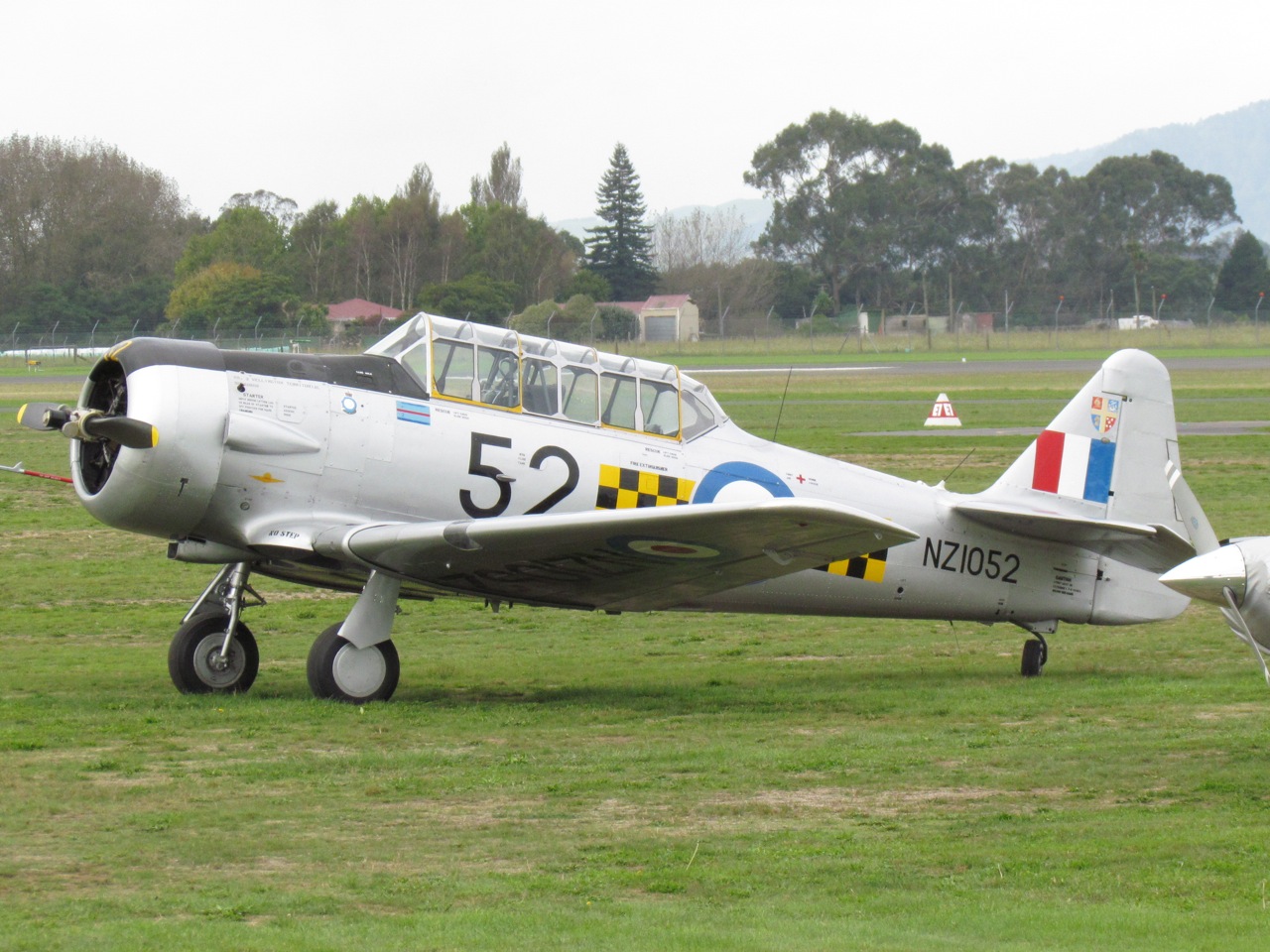
There was an interesting visitor at the Club today - NZ Warbird Harvard 1052 which was parked when I set off and went for a brief flight while I was up (and was the reason for my go-around as he was landing on 07 when I was short final for 18).  
This will be my last flight for a wee while as we are off to the UK for a few weeks - catch you next month.
So, a few photos from today to finish....
North American Harvard 2A, NZ1052 (ZK-MJN) on the WAC flight line

"52" closer up

A152 Aerobat ZK-NPL visiting from New Plymouth

Our own WKF just landed, son of a work colleague in left hand seat
 

24 March 2011

TAUPO TRIP


Two cross countries in a week - not bad!  The lovely wifey told me the other day she was off out this afternoon with friends and suggested I could go for a fly.  Great!!  The only 172 or Archer available was FWS so I booked that and planned a flight to Taupo.

Now, I reckon there are crosswinds and CROSSWINDS!!!!  The lower case ones are at a constant angle and not gusty.  Such was the case at Taupo this afternoon.  The AWIB gave wind at 080º at 11 knots and listening to the calls from other traffic 17 was the "duty" runway.  11 knots of crosswind is about my maximum so I made an early decision to go around if conditions looked worse.  Well, the windsocks were at a constant angle and direction throughout and my landing was nowhere near perfect but not too shabby - I kept straight down the runway as I flared and the upwind wheel touched down first.  I stayed to take a few photos of planes and parachutists, had a cup of hot chocolate at the terminal and returned to Hamilton.

There was an upper-case-with-exclamation-marks crosswind at Hamilton (well, for me at least), i.e. variable in both strength and direction.  The ATIS gave 060º at 10 knots, maximum 20!  I asked for an approach for 07 but the tower said the current surface wind was more northerly, 050 at 8 and would advise later.  I was eventually cleared right base for 36L and on approach the windsocks were cavorting about somewhat (about 40º variability and 8 to 12 knots at least) and a not so pretty landing resulted.  I came in a bit "hot" and although I kicked straight OK I bounced a few times before coming to rest about 50 metres from the end of the strip.  I was beating myself up a bit about it after an otherwise excellent flight.  Enough said - time for some pictures...........
Heading South over the Waikato

Pitts S-1 ZK-RTP being checked over at Hamilton
Hughes 269C ZK-HXS hovering down runway 17 at Taupo
Tandem skydivers 1
Tandem skydivers 2
Cessna line up - nearest 172A, ZK-BPT registered to a Taupo aviation company

23 March 2011

HAMILTON TO TAURANGA AND BACK

Signs that Winter is on its way - Low sun over the sea at 1030.  Waihi and the shadowy Martha Mine in the foreground, Mayor Island in the background
Saturday 19th March

I had prebooked this flight about a month ago when my work colleague, Gavin, asked me if I would take him and his 15 year old son, Mark, who is keen on flying, up for a flight.  Originally I had booked JGP as there was a club trip on but this was changed from all-day to an afternoon jaunt and more aircraft were available, so I changed my booking to WIT.  I thought they would be impressed with the fancy EFIS and other avionics on board (Gavin is a technology enthusiast like most in our profession) and would be more comfortable, too.

I had planned to fly up to Paeroa, then through the Waihi Gap, along the coast of Matakana Island with a landing for coffee at Tauranga before returning direct to Hamilton.  This was modified slightly on passenger request to have a view of the city on the way out so we did a city departure to the North-west turning East to track to Paeroa once North of Ngaruawahia.

The weather was good with only a few patches of fog remaining around the greater Hamilton area and none at the airport or on our intended track.  Wind was Southwesterly at about 3 knots.  We took off uneventfully but on turning downwind to track towards the city it was obvious there was a radio interference problem.  There was a disturbing amount of "white noise" and easy-listening music in the background.  After turning off some avionics (ADF, DME, autopilot) with no effect I turned my attention to our headsets.  As soon as Gavin unplugged his all returned to normal so poor Gavin had to make do with shouting and hand signals for the outward leg.  Inspection of the headset at Tauranga revealed bare wires between the earpieces, probably acting as antennae and picking up the music and other "rubbish".  We also discovered that the radio interference only occurred with the mic lead in so Gavin was able to hear OK on the way back.

We had stunning views over the Waikato and Hauraki plain on the way to Waihi and it stayed clear all the way to Tauranga.  No fog over Matakana Island today.  Gavin never appreciated how extensive the swamp between Tahuna and Paeroa was and now understands why no roads have been built over that area!!

I got the Tauranga ATIS at Waihi Beach.  I called the tower at Bowentown heads and was cleared on a Matakana arrival (seaward of coast, 1500', report approaching harbour mouth).  At the mouth I was instructed to join a "tight" right base for grass 25 - it was more a wide RH downwind and then a shortish approach as I was OK to track the harbour side of the Mount.  The wind was given as 220 at 8 knots so around a 4 knot crosswind but barely noticeable with a straight down the middle, smooth landing on the grass.

Good coffee at the Avgas Cafe as usual.  In the half-hour or so we were there the wind had got up to 220º, 10G18 (G = gusting) so crosswind t/off technique needed.  Our track back to Hamilton was pretty much directly into the wind - GS down to 104 knots (IAS 115 knots).  A bit bumpy over the ridge, not surprising given the gusty breeze and couldn't go higher than 2600' because of a cloud bank just the Tauranga side - once over the top the Waikato was clear.
Tauranga side of the Kaimai range

Approaching Hamilton we were initially cleared for a South arrival - started to track to Cambridge and was than cleared into Scott sector, 1700-2500', track to Matangi.  Hmm - looks like a left base for 18 coming.  Sure was, almost no wind here and another smooth landing, fairly much a precision one, 65KT over the threshold, touching down smoothly just past the displaced threshold marks and able to taxi off at the Echo taxiway (500 metres from the displaced threshold - pretty good WIT, still close to MAUW, and maybe I can take a bit of credit, too!)  Trouble was, there was a plane about to taxi to E1 who was told to hold short but didn't.  I had seen him and stopped.  The tower told me to backtrack along 18R and go via 25 to get to the club but there was no need as said plane turned off onto the grass to make way and was then hand-slapped by the tower as he had encroached on 18R in the process!  Never mind, no collision and all's well that ends well, I guess!!

Gavin summed up the flight in one word, "Stunning!".  Completely agree!!