Hi there again - long time no post, eh? I haven't done as much flying as I would have wished this year what with work, home, overseas trips and weather.
So, I was a little daunted about the airspace changes around Hamilton which came into force on 10 November. I had been to the pilots meeting at the club a few weeks ago which was very informative but there's nothing like the real thing, yes?
Monday 21 November:
So, today's little exercise was to take ZK-WAM up for a few circuits and then exit the control zone for a short local flight and then return using the new procedures.
The weather was perfect. The high winds of Sunday had ceased and it was a variable 5Kt wind at ground level. Visibility was quoted at 25Km but there was a lot of haze (it is Hamilton, after all!!).
I won't go into the details of the airspace changes but suffice to say that the VFR departure and arrival procedures are now runway dependent.
Having arrived at the club bright and early at 0815 I checked in at the desk where instructor, Mandy asked me what I was doing, sent me off to preflight and said she would give me a quick briefing before I went.
So briefing done and off I go from runway 18R (the short GA runway parallel to duty runway 18L). Well, no problem with the circuits; nice landings including a near perfect glide approach (why can't I do that for competitions?, Grr!!).
So, on the third downwind I requested a 18 West departure which was duly approved with the right turn after takeoff instruction given after "cleared touch and go" on finals.
Off to the West at 1200' or below calling clear a lot sooner than before (the control zone has been "shrunk") and switching to the new common frequency for the Raglan CFZ. After a position and intentions call I climbed to 1700' turning North to be about 2 miles west of Temple View, my reference point for the return on a 18 West arrival. There was another 172 around heading in from Raglan way at 2000' so I decided to stay at 1700' (I didn't see him until he was on a short final ahead of me - hazy weather and white painted aircraft!).
Just west of Temple View I called the tower, got a clearance for the 18 West arrival and, despite having to stay at 1700' until early base leg got down for a pretty good landing on 18R runway.
Mission accomplished with no real dramas. Next step: an East departure, maybe to Tauranga where there have been similar airspace changes.
23 November 2016

19 February 2016
BEST LAID PLANS.....
...Of Mice, Men and VFR Pilots, etc.
Monday 15th February
First post for a very long while but today's tale is worth telling.
I had planned an aviation outing with youngest daughter in early January - Hamilton to Tauranga for brunch and back home by early afternoon, but was frustrated by the weather - very cloudy Kaimai ranges and raining at the Waihi Gap so it was an early return home then.
So, today was our second attempt at the same flight.
Weather seemed OK when checking the night before - rain predicted in Tauranga early morning (had cleared by the time I checked the weather this morning) and again after 1600 but OK for VFR in between and good conditions in Hamilton all day. Well, you know weather forecasts!!
It was a little cloudy but the cloud over the ridge by Wairere falls was well clear (1000' plus of clearance to cross when we got there) so we flew over on a direct track from Hamilton without any dramas. A bit breezy in Tauranga at 13 Knots but 070º magnetic so straight down 07/25 and no problem for landing.
We had an excellent brunch at the Avgas Cafe but in the half hour or so we spent there the weather had closed right in (helped by the wind backing to the North-East driving the cloud towards the ranges). I thought it was worthwhile trying to get back via the Waihi Gap as the ATIS appeared favourable (just) but after taking off for a look I couldn't see Matakana Island behind the Mount (see photos) and the cloud base and vis were well below that on the information so it was a call to tower to return for landing. By the time we got down and taxied clear it was actively raining quite hard so back to the cafe for a sit down and chat about the situation. Once back there the wind had dropped away to variable 4 Knots so the low cloud was likely to be around for a while.
I phoned the tower and the guys there were very helpful. They invited us up for a look at the weather from their excellent vantage point. Completely VFR unflyable over the Kaimais but the controllers assured me it was starting to clear. Also, had a PIREP (pilot report) that the cloud base at the Waihi gap was ~1200' so that route was out and it looked even worse to the East for the other lower route via Te Puke. No choice other than to sit it out. I called the aero club in Hamilton to tell them we were "stuck" and was reassured that weather conditions were still good over there and likely to remain so if we did make it over the hills.
After a pot of tea at the cafe, the sun was starting to break through over the sea so time to check in with the tower again. They reckoned it was clearing over the gap where the road (Highway 29) goes over so I went up to the tower for another look and, sure enough, the Kaimai ridge could clearly be seen where the road goes over and also at Wairere falls. The controllers said that a twinstar had just crossed the range VFR a short time before.
So, after a call to the club in Hamilton with my intention which they were happy with, we set off. The route via the road looked best and we were able to climb to 2800' once clear of the zone which was plenty of room to get over the gap (road height is about 1700' and the highest point - a mast to the east is ~2200'). We flew though a light shower but crossed the ridge safely, heading towards the mast first and then turning right to cross diagonally over the lowest point. I called Tauranga tower to tell them we were over OK and to thank them for their help. Apart from a few bumps on the lee side of the range (surprise, surprise!!), it was an uneventful flight back home to Hamilton.
Lessons learnt and heeded (mainly):
1) Weather forecasts are FORECASTS and, although essential to preflight planning, are not 100% reliable. Conditions can change sooner and quicker than predicted.
2) Have a back-up plan - staying a night in a motel may cost but is a lot better than having to do a precautionary landing on a beach/in a paddock or worse.
3) Don't let that dreaded get-there/home-itis grab you. We contacted middle daughter in Hamilton to sort out some stuff which we had planned to get back in plenty of time for so felt relaxed about the time factor.
4) Get help and information - the aviation community are always very helpful I have found and the guys in the tower today were worth their weight in gold. Thanks to them, an instructor at the club who told me "Not to push it", and, I think, a bit of common sense from me, it all ended well and safely.
A challenging but good day flying in the end. Finally, some photos (courtesy daughter's phone):
Monday 15th February
First post for a very long while but today's tale is worth telling.
I had planned an aviation outing with youngest daughter in early January - Hamilton to Tauranga for brunch and back home by early afternoon, but was frustrated by the weather - very cloudy Kaimai ranges and raining at the Waihi Gap so it was an early return home then.
So, today was our second attempt at the same flight.
Weather seemed OK when checking the night before - rain predicted in Tauranga early morning (had cleared by the time I checked the weather this morning) and again after 1600 but OK for VFR in between and good conditions in Hamilton all day. Well, you know weather forecasts!!
It was a little cloudy but the cloud over the ridge by Wairere falls was well clear (1000' plus of clearance to cross when we got there) so we flew over on a direct track from Hamilton without any dramas. A bit breezy in Tauranga at 13 Knots but 070º magnetic so straight down 07/25 and no problem for landing.
We had an excellent brunch at the Avgas Cafe but in the half hour or so we spent there the weather had closed right in (helped by the wind backing to the North-East driving the cloud towards the ranges). I thought it was worthwhile trying to get back via the Waihi Gap as the ATIS appeared favourable (just) but after taking off for a look I couldn't see Matakana Island behind the Mount (see photos) and the cloud base and vis were well below that on the information so it was a call to tower to return for landing. By the time we got down and taxied clear it was actively raining quite hard so back to the cafe for a sit down and chat about the situation. Once back there the wind had dropped away to variable 4 Knots so the low cloud was likely to be around for a while.
I phoned the tower and the guys there were very helpful. They invited us up for a look at the weather from their excellent vantage point. Completely VFR unflyable over the Kaimais but the controllers assured me it was starting to clear. Also, had a PIREP (pilot report) that the cloud base at the Waihi gap was ~1200' so that route was out and it looked even worse to the East for the other lower route via Te Puke. No choice other than to sit it out. I called the aero club in Hamilton to tell them we were "stuck" and was reassured that weather conditions were still good over there and likely to remain so if we did make it over the hills.
After a pot of tea at the cafe, the sun was starting to break through over the sea so time to check in with the tower again. They reckoned it was clearing over the gap where the road (Highway 29) goes over so I went up to the tower for another look and, sure enough, the Kaimai ridge could clearly be seen where the road goes over and also at Wairere falls. The controllers said that a twinstar had just crossed the range VFR a short time before.
So, after a call to the club in Hamilton with my intention which they were happy with, we set off. The route via the road looked best and we were able to climb to 2800' once clear of the zone which was plenty of room to get over the gap (road height is about 1700' and the highest point - a mast to the east is ~2200'). We flew though a light shower but crossed the ridge safely, heading towards the mast first and then turning right to cross diagonally over the lowest point. I called Tauranga tower to tell them we were over OK and to thank them for their help. Apart from a few bumps on the lee side of the range (surprise, surprise!!), it was an uneventful flight back home to Hamilton.
Lessons learnt and heeded (mainly):
1) Weather forecasts are FORECASTS and, although essential to preflight planning, are not 100% reliable. Conditions can change sooner and quicker than predicted.
2) Have a back-up plan - staying a night in a motel may cost but is a lot better than having to do a precautionary landing on a beach/in a paddock or worse.
3) Don't let that dreaded get-there/home-itis grab you. We contacted middle daughter in Hamilton to sort out some stuff which we had planned to get back in plenty of time for so felt relaxed about the time factor.
4) Get help and information - the aviation community are always very helpful I have found and the guys in the tower today were worth their weight in gold. Thanks to them, an instructor at the club who told me "Not to push it", and, I think, a bit of common sense from me, it all ended well and safely.
A challenging but good day flying in the end. Finally, some photos (courtesy daughter's phone):
 |
| Looking pretty good over the Waikato - soon to change, though!! |
 |
| Pretty, pretty |
 |
| After Brunch... not too good to the East... |
 |
| And worse beyond the Mount!: Time to land - 10º flap already |
12 July 2015
IT'S BEEN A WHILE....
.. as they say, about 10 months, in fact!!
So , why no posts? Well, I haven't done a great deal of interesting flying, have been more busy at work and moved house late last year. It also seems I got out of the habit of writing on this blog.
So, time for an update.
I haven't been entirely idle on the flying front but have done a fair bit less than usual since the club competitions last September which meant I got out of currency on both 172s and Cherokees and needed a few dual flights to get "all sorted" again.
Having got current again just before Christmas I booked WAM early in the New Year to take my oldest daughter who was over from Melbourne for the holidays and her flatmate from Aussie who had never been to NZ before up for a bit of a scenic. It was a stunningly good day for flying, sunny with an 8-10 knot wind from the West so we took off from 25 making a right turn after takeoff to fly over the city and thence through the Taupiri Gap to Huntly, out to the coast to Raglan and then back to Hamilton. The girls enjoyed the flight which was very pleasing.
Over the next couple of months it was mainly circuits to keep current and a few flights in the Stearman over at Tauranga. Then a trip to the UK for a few weeks and then, suddenly it seemed, the year was halfway over!
So, to get completely up-to-date I have been up twice since getting back, the first for a Sunday afternoon club competition - bombing - which was fun but I didn't do too well. That brings us up to yesterday....
I had booked WAM to go up with instructor, Rob for a currency check. It had been about -3C overnight and on arriving at the club the first job was to de-ice the wings of WAM. This involves buckets of warm water, wiping down, checking fuel drains aren't still blocked, seeing that the water has re-frozen on the shady side and doing it again. One of those "fun" jobs just above the level of cleaning out a chemical toilet - much less smelly though :)
Rob and I were eventually happy to get going and all went pretty well. I flew three circuits with Rob, he threw in a glide approach and an EFATO (engine failure after take-off) which went well, all landings were on the good side of acceptable so Rob was happy to jump out and let me do three on my own. Those landing were also pretty good (one touch down point a bit further than intended but still smooth) and was very happy with that. A good, if a little chilly morning's flying.
So , why no posts? Well, I haven't done a great deal of interesting flying, have been more busy at work and moved house late last year. It also seems I got out of the habit of writing on this blog.
So, time for an update.
I haven't been entirely idle on the flying front but have done a fair bit less than usual since the club competitions last September which meant I got out of currency on both 172s and Cherokees and needed a few dual flights to get "all sorted" again.
Having got current again just before Christmas I booked WAM early in the New Year to take my oldest daughter who was over from Melbourne for the holidays and her flatmate from Aussie who had never been to NZ before up for a bit of a scenic. It was a stunningly good day for flying, sunny with an 8-10 knot wind from the West so we took off from 25 making a right turn after takeoff to fly over the city and thence through the Taupiri Gap to Huntly, out to the coast to Raglan and then back to Hamilton. The girls enjoyed the flight which was very pleasing.
Over the next couple of months it was mainly circuits to keep current and a few flights in the Stearman over at Tauranga. Then a trip to the UK for a few weeks and then, suddenly it seemed, the year was halfway over!
So, to get completely up-to-date I have been up twice since getting back, the first for a Sunday afternoon club competition - bombing - which was fun but I didn't do too well. That brings us up to yesterday....
I had booked WAM to go up with instructor, Rob for a currency check. It had been about -3C overnight and on arriving at the club the first job was to de-ice the wings of WAM. This involves buckets of warm water, wiping down, checking fuel drains aren't still blocked, seeing that the water has re-frozen on the shady side and doing it again. One of those "fun" jobs just above the level of cleaning out a chemical toilet - much less smelly though :)
 |
| Cold but beautiful! |
07 September 2014
CLUB COMPETITIONS 2014
Club competition time again - how time flies!!
Saturday 6th September
Day one. A bit cloudy but well flyable with a strengthening south-easterly breeze so Grass runway 07R was marked out for the landing grid.
Gentleman's Circuits: started fine with steady 80Kt in the climb, remembering lookout, downwind checks and nice and steady at 70Kt on base, two stages flap and then the turn to final close to 500' agl, full flap and trimming for nominated speed of 60Kt. Looking good? Well, not quite. I had seen one of the previous competitors get pretty low on short final and land short so I kept the power on a bit longer than usual and... I am still looking low. Now, I am guessing (several hours later) that the wind at 3-400' up was somewhat stronger than on the ground (maybe shelter from buildings a factor, too) and that is why I am losing height as the wind has (effectively) dropped. I recovered OK to get over the threshold but still low. I had no height left to hold it off and the touchdown was well short of the "perfect" 50 point box (about a 10 I reckoned).
Next circuit, all well until short final where I looked high, pulled power to get down and ended up with a tad too much downward momentum and a bounce from a good position on the grid to a longish way down and, probably, another 10. Not what I wanted at all and I doubt whether I will place in this event.
Senior landings: this wasn't a lot better. At least this is only marked from base leg as I forgot we had QFE (aerodrome pressure; i.e: altimeter set at zero on the ground) and turned crosswind at 700' (usual height if QNH = ambient pressure is set). Ooops!!
We had to extend downwind on tower's instructions and ended up on a longer final than ideal and my landing, although good and smooth was nowhere near the centre of the grid. The second circuit was much the same. All good in the air but a poor position on the landing. Grrr!! A few others had similar problems so thinking it may be close between myself and flyinkiwi for that "double or quits" beer challenge!
Non-Instrument Circuits: this was after lunch and maybe a few handfuls of chips (the hot type - the others, old chap, are crisps where I come from) helped because this felt the best of the competition exercises for me. The idea is you fly two standard circuits with the flying instruments only visible to the air judge in the right hand seat. The competitor nominates take-off and climb speeds, downwind engine RPM, base and finals speeds. Challenging, but it all went fine in the air and, probably because I was nice and relaxed, the landings were on, or very close to the centre of the grid but that doesn't matter for this exercise as all you have to do is make a good or safe landing to score points. Of course, I have no idea how close I was to my nominated speeds or how accurate my height judgement was but was pleased enough with that performance.
Sunday 7th September
Day two and I was only doing the forced landing competition today. Lovely sunny day with a decreasing wind from the South so 18R was marked out for the landing grid
Forced landing without power: in this you take off, climb in the circuit pattern to 2500', the air judge pulls the throttle to simulate the engine failure and you have to go through a forced landing exercise in which you are marked for doing all the engine failure checks, mayday call (simulated), passenger briefing, glide speed control, height at 1000' point, general airmanship (lookouts, etc.), and then the "dead-stick" landing on the runway grid which is scored as for the spot landings. After the first touch and go you do it all over again from a different engine failure height.
Well, it started OK climbing up to 2500' on late downwind but then a Dash-8 did a go-around so we were given an orbit at 2500' which felt odd at that altitude and once complete we crossed the downwind threshold of 18L to be West of the strip for the start of the exercise.
First throttle pull was at 2500' and I went through the checks pretty well, I thought (missed engine instruments and partial power check) but nailed the speed and check points and was feeling pretty good about it all until the turn to final where I was too high. I managed to sort it with flap and a bit of S-turning but touched down way too long and a zero for that landing!
Second go was not that great: throttle pull at 2000' this time - no way going to make 1500' point so headed straight for 1000' point and nailed that. Again far too high on final and this time flap and S-turns weren't going to sort it. I was up to 80Kt+ trying to make the runway which wasn't going to happen so, power on, go around and a DQ for that half of the exercise. Grumble, grumble!!
Oh well, it was all good fun and educational and there is always next year.
Finally, a few photos (all from Saturday):
Saturday 6th September
Day one. A bit cloudy but well flyable with a strengthening south-easterly breeze so Grass runway 07R was marked out for the landing grid.
Gentleman's Circuits: started fine with steady 80Kt in the climb, remembering lookout, downwind checks and nice and steady at 70Kt on base, two stages flap and then the turn to final close to 500' agl, full flap and trimming for nominated speed of 60Kt. Looking good? Well, not quite. I had seen one of the previous competitors get pretty low on short final and land short so I kept the power on a bit longer than usual and... I am still looking low. Now, I am guessing (several hours later) that the wind at 3-400' up was somewhat stronger than on the ground (maybe shelter from buildings a factor, too) and that is why I am losing height as the wind has (effectively) dropped. I recovered OK to get over the threshold but still low. I had no height left to hold it off and the touchdown was well short of the "perfect" 50 point box (about a 10 I reckoned).
Next circuit, all well until short final where I looked high, pulled power to get down and ended up with a tad too much downward momentum and a bounce from a good position on the grid to a longish way down and, probably, another 10. Not what I wanted at all and I doubt whether I will place in this event.
Senior landings: this wasn't a lot better. At least this is only marked from base leg as I forgot we had QFE (aerodrome pressure; i.e: altimeter set at zero on the ground) and turned crosswind at 700' (usual height if QNH = ambient pressure is set). Ooops!!
We had to extend downwind on tower's instructions and ended up on a longer final than ideal and my landing, although good and smooth was nowhere near the centre of the grid. The second circuit was much the same. All good in the air but a poor position on the landing. Grrr!! A few others had similar problems so thinking it may be close between myself and flyinkiwi for that "double or quits" beer challenge!
Non-Instrument Circuits: this was after lunch and maybe a few handfuls of chips (the hot type - the others, old chap, are crisps where I come from) helped because this felt the best of the competition exercises for me. The idea is you fly two standard circuits with the flying instruments only visible to the air judge in the right hand seat. The competitor nominates take-off and climb speeds, downwind engine RPM, base and finals speeds. Challenging, but it all went fine in the air and, probably because I was nice and relaxed, the landings were on, or very close to the centre of the grid but that doesn't matter for this exercise as all you have to do is make a good or safe landing to score points. Of course, I have no idea how close I was to my nominated speeds or how accurate my height judgement was but was pleased enough with that performance.
Sunday 7th September
Day two and I was only doing the forced landing competition today. Lovely sunny day with a decreasing wind from the South so 18R was marked out for the landing grid
Forced landing without power: in this you take off, climb in the circuit pattern to 2500', the air judge pulls the throttle to simulate the engine failure and you have to go through a forced landing exercise in which you are marked for doing all the engine failure checks, mayday call (simulated), passenger briefing, glide speed control, height at 1000' point, general airmanship (lookouts, etc.), and then the "dead-stick" landing on the runway grid which is scored as for the spot landings. After the first touch and go you do it all over again from a different engine failure height.
Well, it started OK climbing up to 2500' on late downwind but then a Dash-8 did a go-around so we were given an orbit at 2500' which felt odd at that altitude and once complete we crossed the downwind threshold of 18L to be West of the strip for the start of the exercise.
First throttle pull was at 2500' and I went through the checks pretty well, I thought (missed engine instruments and partial power check) but nailed the speed and check points and was feeling pretty good about it all until the turn to final where I was too high. I managed to sort it with flap and a bit of S-turning but touched down way too long and a zero for that landing!
Second go was not that great: throttle pull at 2000' this time - no way going to make 1500' point so headed straight for 1000' point and nailed that. Again far too high on final and this time flap and S-turns weren't going to sort it. I was up to 80Kt+ trying to make the runway which wasn't going to happen so, power on, go around and a DQ for that half of the exercise. Grumble, grumble!!
Oh well, it was all good fun and educational and there is always next year.
Finally, a few photos (all from Saturday):
 |
| C-172R "WAM" waits to take off |
 |
| "WAM" short final |
 |
| Aerospool Dynamic "MLC" landing |
 |
| Robin/Alpha R2160 "WCD" short final... |
 |
| ... and about to touch down |
 |
| Ground hazard? Lots of plovers around the field at present - wonder why?? |
09 August 2014
A BIT OF WINDY CROSS COUNTRY
Having got current again a few weeks ago it was time for a bit of cross country in "WIT", the club's Archer III. One of my middle daughter's friends, Jordan, had wanted to come flying with me for some time and today was the day. Over the past week, I hadn't been too optimistic about getting up as we had had rain, wind or both for several days but today dawned bright and clear with a light breeze, at least initially - more on that later!
I arrived at the club and before preflighting discussed my plans (Hamilton (HN) to Tauranga (TG) via the Waihi Gap - coffee at TG then back to HN over the Kaimais) with Instructor, Rob. Well, the wind at TG was against that plan: it had gone from 220º at 11 knots at 0830 when I last checked at home (x-wind on runway 25 approx 6Kt) to 190º at 13Kt at 1000 (12 knot x-wind - too much for me particularly with a likely freshening breeze). Rob informed me that any significant cross-wind at TG was "no-go" for landing a club aircraft and signed me out with the caveat of no landing at TG. I told him I would modify my plans and just go to the coast at Waihi and then back to HN.
By this time Jordan had arrived and I showed him around the plane while pre-flighting and we took off from runway 18L into what appeared to be a strengthening wind (200º at 9Kt at 0830 was 180º at 12 max 15Kt at take off time).
We left on a West departure over the city turning to track towards Paeroa once North of Horotiu and well clear of the HN control zone. We had surprisingly few bumps along the way. There was a bit of wind-shear at 500' above ground level (lower and less than expected, probably indicating that the surface wind was becoming closer to the 2000' forecast wind of 190º at 20Kt). It became a bit bumpy again climbing through 2200' over the city and stayed that way so I elected to go back down to 2000' where it was smooth. I didn't want to upset my "first-timer" passenger. There was one quite big bump between the small hills just North of Morrinsville but otherwise the flight was smooth all the way to the gap and only a few bumps between the hills there (I had climbed up to 2400' by then to get above any "chop" and that worked well).
Jordan seemed to be really enjoying the flight and the scenery by now so we got to the coast at Waihi Beach, did a 180º to track back past the Martha Mine on the right hand side to give Jordan the aerial view of that landmark. Then it was directly back to HN once clear of the gap just South of Paeroa.
At Morrinsville I got the Hamilton ATIS which confirmed the strengthening wind, still 180º but now 17 max 20 knots. I requested and was given a Mystery Creek arrival. As I came abeam Matangi I was just about to call the tower when they came on the radio to give me "descent unrestricted, join left base for 18R, number 2 behind Cessna on downwind". They must have read my mind! I called back the usual read back including looking for traffic which I spotted a few seconds after making the call - he/she was well in front of me.
Given the wind, I elected 80 knots for base and 70-75 with two stages of flap for final and all seemed to be good until just crossing the threshold, I flared a bit too high, was losing speed, and much faster that I can type this, "Dammit, too high, too slow, this won't end well, go around" flashed though my brain and I had the throttle full open before the thought was finished! Raised flap to one notch, informed the tower, "WIT going around" and then flew a pretty good and accurate circuit back to base leg again having decided to have 75-80Kt on final with only one notch of flap this time as I had noticed my ground speed on the GPS had only been 55Kt on the previous approach and, maybe, I had been a bit too slow for the breezy conditions (the wind was somewhat variable in direction as well as speed). This was a good decision as I flew a nicely stable approach, timing the flare perfectly to roll the main wheels on the runway centreline just beyond the numbers in which was a pretty good, smooth touch down given the conditions.
Jordan said afterwards that he thoroughly enjoyed the flight and wasn't at all fazed by the go-around (I think a lot of first-timers would have been). I was pleased that all the training and experience "kicked-in" almost sub-consciously with the end result a very satisfying flight.
I arrived at the club and before preflighting discussed my plans (Hamilton (HN) to Tauranga (TG) via the Waihi Gap - coffee at TG then back to HN over the Kaimais) with Instructor, Rob. Well, the wind at TG was against that plan: it had gone from 220º at 11 knots at 0830 when I last checked at home (x-wind on runway 25 approx 6Kt) to 190º at 13Kt at 1000 (12 knot x-wind - too much for me particularly with a likely freshening breeze). Rob informed me that any significant cross-wind at TG was "no-go" for landing a club aircraft and signed me out with the caveat of no landing at TG. I told him I would modify my plans and just go to the coast at Waihi and then back to HN.
By this time Jordan had arrived and I showed him around the plane while pre-flighting and we took off from runway 18L into what appeared to be a strengthening wind (200º at 9Kt at 0830 was 180º at 12 max 15Kt at take off time).
We left on a West departure over the city turning to track towards Paeroa once North of Horotiu and well clear of the HN control zone. We had surprisingly few bumps along the way. There was a bit of wind-shear at 500' above ground level (lower and less than expected, probably indicating that the surface wind was becoming closer to the 2000' forecast wind of 190º at 20Kt). It became a bit bumpy again climbing through 2200' over the city and stayed that way so I elected to go back down to 2000' where it was smooth. I didn't want to upset my "first-timer" passenger. There was one quite big bump between the small hills just North of Morrinsville but otherwise the flight was smooth all the way to the gap and only a few bumps between the hills there (I had climbed up to 2400' by then to get above any "chop" and that worked well).
Jordan seemed to be really enjoying the flight and the scenery by now so we got to the coast at Waihi Beach, did a 180º to track back past the Martha Mine on the right hand side to give Jordan the aerial view of that landmark. Then it was directly back to HN once clear of the gap just South of Paeroa.
At Morrinsville I got the Hamilton ATIS which confirmed the strengthening wind, still 180º but now 17 max 20 knots. I requested and was given a Mystery Creek arrival. As I came abeam Matangi I was just about to call the tower when they came on the radio to give me "descent unrestricted, join left base for 18R, number 2 behind Cessna on downwind". They must have read my mind! I called back the usual read back including looking for traffic which I spotted a few seconds after making the call - he/she was well in front of me.
Given the wind, I elected 80 knots for base and 70-75 with two stages of flap for final and all seemed to be good until just crossing the threshold, I flared a bit too high, was losing speed, and much faster that I can type this, "Dammit, too high, too slow, this won't end well, go around" flashed though my brain and I had the throttle full open before the thought was finished! Raised flap to one notch, informed the tower, "WIT going around" and then flew a pretty good and accurate circuit back to base leg again having decided to have 75-80Kt on final with only one notch of flap this time as I had noticed my ground speed on the GPS had only been 55Kt on the previous approach and, maybe, I had been a bit too slow for the breezy conditions (the wind was somewhat variable in direction as well as speed). This was a good decision as I flew a nicely stable approach, timing the flare perfectly to roll the main wheels on the runway centreline just beyond the numbers in which was a pretty good, smooth touch down given the conditions.
Jordan said afterwards that he thoroughly enjoyed the flight and wasn't at all fazed by the go-around (I think a lot of first-timers would have been). I was pleased that all the training and experience "kicked-in" almost sub-consciously with the end result a very satisfying flight.
21 July 2014
BACK IN THE LEFT HAND SEAT
Well, it's been a while (> 3 months), as they say, but it's time, long overdue, for another post. I had been away (UK and Canada) for a month, mid-May to mid-June and, thanks to some truly awful weather had four bookings cancelled since getting back.
Tuesday 15th July
Finally, a fine dawn with no rain, fog, adverse wind or low cloud and an available aircraft and instructor. It had been pretty cold overnight but just above zero so there was no frost or ice on the wings of Archer, WIT and instructor, Russell and I were off into the circuit 3 months to the day when I last flew the type.
The first circuit went really well with a good landing and all I forgot was the fuel pump switch to on at pre-takeoff (tut, tut!!). The next was OK, too and Russell said he would hop out and let me go around on my own if the next landing was good (no pressure, eh?!).
Well, it was fine, Russell got out, and I was off for three circuits on my own with no real dramas (lost flying speed about 10cm above the runway on the last trying for a real precision landing on 18R but it was only a gentle bump) and current again on Archers.
Next step, current on 172s.......
Monday 21st July (today)
After a lot of rain overnight (although not as bad as Auckland which was awful driving back to Hamilton last night) I didn't have great hopes of getting up but, there was no wind to speak of, few cloud at 5,500' and all good to go up in "WAM" (my first flight since "WAM"'s recent spell in maintenance) with instructor, Chris for a reprise of last week in a different type.
No dramas on pre-flight, run-ups, etc., and into the circuit. First approach was good and stable but drifted a bit along 18R and landed a bit longer than intended. The next on the big 18L was precisely on the designated spot but a bit late on the flare. Floated a bit on the third and Chris made the comment that we should be a little slower (55Kt) on short final) as the plane was very light (just enough fuel + reserve for the exercise). Got it nailed just fine on the fourth and Chris hopped out, having complimented me on good, stable approaches (which was nice) and I was off on four of my own.
Chris had set the timer on the GPS for the fuel (-reserve) available and that zeroed on very short final for 18R to land on the last lap, taxiing off the runway with about +45 seconds into the reserve.
So, all good, current again on both Archers and 172s and looking forward to a bit more flying in the coming weeks.
Tuesday 15th July
Finally, a fine dawn with no rain, fog, adverse wind or low cloud and an available aircraft and instructor. It had been pretty cold overnight but just above zero so there was no frost or ice on the wings of Archer, WIT and instructor, Russell and I were off into the circuit 3 months to the day when I last flew the type.
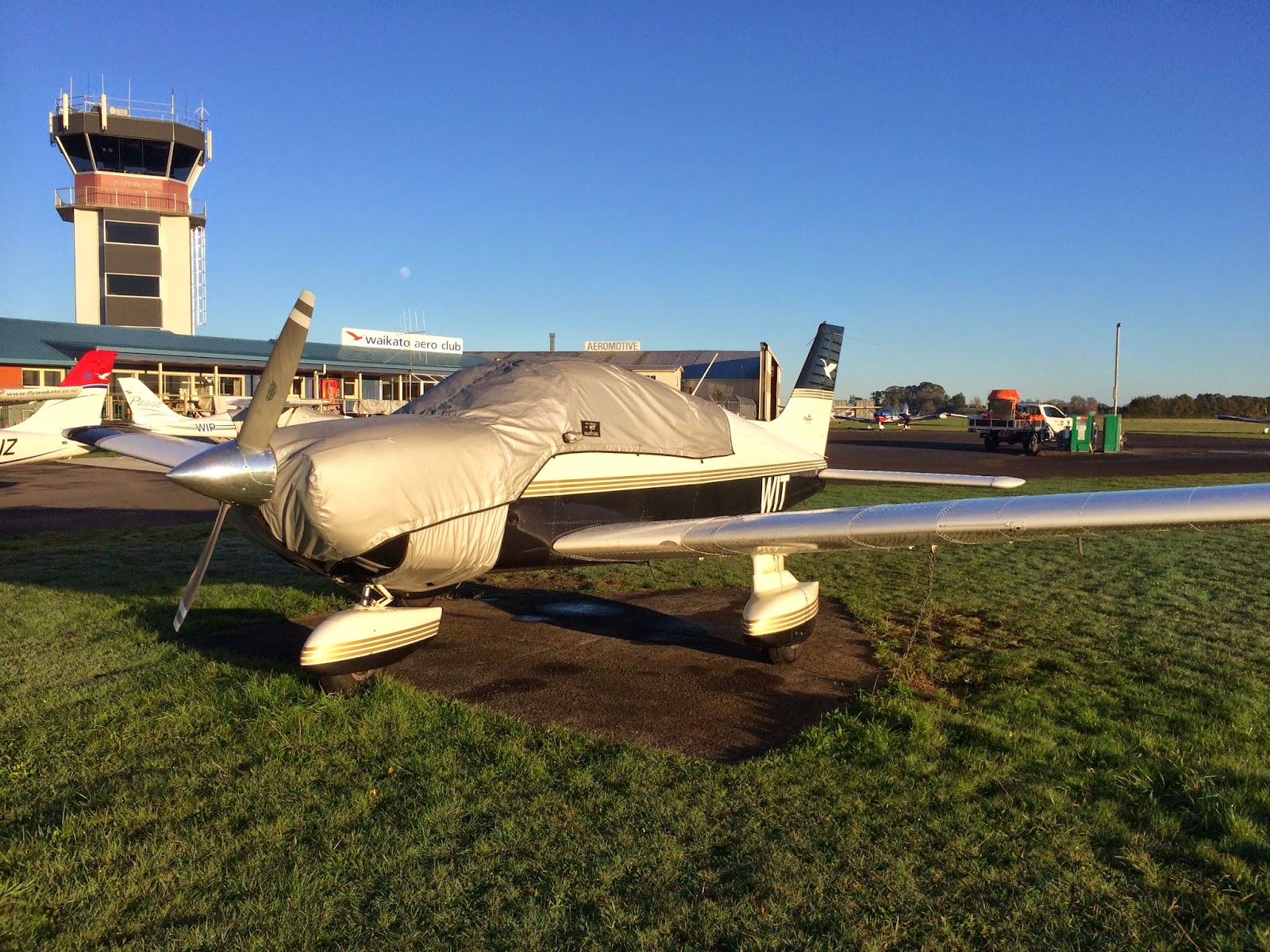 |
| WIT awaits in the early morning sun |
The first circuit went really well with a good landing and all I forgot was the fuel pump switch to on at pre-takeoff (tut, tut!!). The next was OK, too and Russell said he would hop out and let me go around on my own if the next landing was good (no pressure, eh?!).
Well, it was fine, Russell got out, and I was off for three circuits on my own with no real dramas (lost flying speed about 10cm above the runway on the last trying for a real precision landing on 18R but it was only a gentle bump) and current again on Archers.
Next step, current on 172s.......
Monday 21st July (today)
After a lot of rain overnight (although not as bad as Auckland which was awful driving back to Hamilton last night) I didn't have great hopes of getting up but, there was no wind to speak of, few cloud at 5,500' and all good to go up in "WAM" (my first flight since "WAM"'s recent spell in maintenance) with instructor, Chris for a reprise of last week in a different type.
No dramas on pre-flight, run-ups, etc., and into the circuit. First approach was good and stable but drifted a bit along 18R and landed a bit longer than intended. The next on the big 18L was precisely on the designated spot but a bit late on the flare. Floated a bit on the third and Chris made the comment that we should be a little slower (55Kt) on short final) as the plane was very light (just enough fuel + reserve for the exercise). Got it nailed just fine on the fourth and Chris hopped out, having complimented me on good, stable approaches (which was nice) and I was off on four of my own.
Chris had set the timer on the GPS for the fuel (-reserve) available and that zeroed on very short final for 18R to land on the last lap, taxiing off the runway with about +45 seconds into the reserve.
So, all good, current again on both Archers and 172s and looking forward to a bit more flying in the coming weeks.
08 April 2014
ABORT, ABORT!
Having not done any cross-country flying for some time I thought it was about time I did something more than just a local flight and a few circuits here at Hamilton or flying the Stearman when we are over "at the beach". And when my rather-nervous-flyer wife said she would like to come on a flight over to Tauranga for an expensive coffee while I went up in the Stearman it seemed too good an opportunity to miss.
So, having booked Archer III, WIT for this morning we trekked over to the club for 0830 to preflight and get going. I had been somewhat nervously watching the weather over the past few days but it was clear at Hamilton airport, the bad weather at Tauranga was not forecast to arrive until 1400 and, although there seemed to be quite a lot of low cloud around between us and the Kaimai Range, I knew from past experience it was only only really possible to assess whether the range was passable once up in the air (I have taken four different routes over the range or through the Waihi Gap in the past).
So, we taxied out to the run-up area beside the threshold of 18R and the first trouble struck. On engine run-up I switched the left magneto off; all good, 50 rpm drop at the worst on the right mag, and then tried the left mag alone; oh ****! 300 rpm drop at least!! Having encountered this situation before I reckoned it was likely fouled spark plug(s) on the left mag circuit so I leaned off the mixture a couple of times while revving up and tried again. No joy, still at least 200 drop so I tried leaning off one more time and, hey, all good, only a 50ish rpm drop now and it was likely fouled plug(s) after all.
After that we took off from 18R without any dramas and headed off on an East departure via Scotsman Valley (EastNE). Once clear of the zone at around 2000' it was obvious there was a problem. A sea of cloud confronted me more or less all the way from just beyond the valley all the way to the Kaimais with only the top of Mount Aroha visible poking out above the clouds.
It wasn't all that great where I was, either. I had been following a Katana about 3-4 miles ahead and spotted him turning around and heading back towards Hamilton. I also had needed to descend to around 1200' to avoid cloud. It looked a little clearer around Morrinsville to the North so I did a climbing turn to the left to head that way and avoid the oncoming traffic.
Once a little to the South of Morrinsville I had a good look around. The visibility looked very poor to the North as well as to the East and tracking North to go through the Waihi Gap did not look an attractive option and I made the decision to return to Hamilton (my good lady in the right seat was looking a tad nervous at this point).
By the time I got my radio call in to the tower I was skirting the Northern edge of the control zone and was cleared to join straight in for 18L (no IFR or commercial flights in the vicinity, then). An uneventful approach and landed just after a Katana which I think was the one that passed me in Scotsman Valley. A good call in the end as I later found out from Pete, the Stearman instructor, that the weather "packed in" at Tauranga at lunchtime and it may have been a little dodgy or even impossible to get back home if we had got there.
So, having booked Archer III, WIT for this morning we trekked over to the club for 0830 to preflight and get going. I had been somewhat nervously watching the weather over the past few days but it was clear at Hamilton airport, the bad weather at Tauranga was not forecast to arrive until 1400 and, although there seemed to be quite a lot of low cloud around between us and the Kaimai Range, I knew from past experience it was only only really possible to assess whether the range was passable once up in the air (I have taken four different routes over the range or through the Waihi Gap in the past).
So, we taxied out to the run-up area beside the threshold of 18R and the first trouble struck. On engine run-up I switched the left magneto off; all good, 50 rpm drop at the worst on the right mag, and then tried the left mag alone; oh ****! 300 rpm drop at least!! Having encountered this situation before I reckoned it was likely fouled spark plug(s) on the left mag circuit so I leaned off the mixture a couple of times while revving up and tried again. No joy, still at least 200 drop so I tried leaning off one more time and, hey, all good, only a 50ish rpm drop now and it was likely fouled plug(s) after all.
After that we took off from 18R without any dramas and headed off on an East departure via Scotsman Valley (EastNE). Once clear of the zone at around 2000' it was obvious there was a problem. A sea of cloud confronted me more or less all the way from just beyond the valley all the way to the Kaimais with only the top of Mount Aroha visible poking out above the clouds.
It wasn't all that great where I was, either. I had been following a Katana about 3-4 miles ahead and spotted him turning around and heading back towards Hamilton. I also had needed to descend to around 1200' to avoid cloud. It looked a little clearer around Morrinsville to the North so I did a climbing turn to the left to head that way and avoid the oncoming traffic.
Once a little to the South of Morrinsville I had a good look around. The visibility looked very poor to the North as well as to the East and tracking North to go through the Waihi Gap did not look an attractive option and I made the decision to return to Hamilton (my good lady in the right seat was looking a tad nervous at this point).
By the time I got my radio call in to the tower I was skirting the Northern edge of the control zone and was cleared to join straight in for 18L (no IFR or commercial flights in the vicinity, then). An uneventful approach and landed just after a Katana which I think was the one that passed me in Scotsman Valley. A good call in the end as I later found out from Pete, the Stearman instructor, that the weather "packed in" at Tauranga at lunchtime and it may have been a little dodgy or even impossible to get back home if we had got there.
06 February 2014
BFR SORTED AND GETTING CURRENT
HAPPY NEW YEAR TO ALL
Well, I haven't posted for a while (three months and a day to be exact) so this is a bit of an update for anyone who might be interested.
The previously ongoing and now complete BFR saga:
Saturday 16 November; a great day for flying and was able to do about four circuits with instructor, Peter getting in a glide approach (which ended up flapless, too), an engine failure after takeoff and a precision landing before the tower called up to say circuits were suspended until further notice due IFR traffic so we had to call it a day there. Anyway, Peter was happy with what I had done but there was one small snag. You see, it was a "great day for flying"; that is, hardly any wind so no good for a crosswind sign off, sigh!!
Tuesday 19th November; I had made a booking early afternoon but was phoned at lunchtime to say the wind was very light but might pick up later in the day. I was free so asked instructor, Russell, to give me a call if the wind became right. Well, the wind did pick up when, wait for it, a group of CBs (cumulo-nimbus thunder clouds) was approaching the airport so no-go again. The storm hit about half an hour after I would have started flying so that was a good call.
Tuesday 26th November; finally, good to go for crosswind circuits. A gusty 8-10 knot crosswind on runway 36 was deemed sufficient for instructor, Russell to "sort me out". The conditions overall with an increasing wind were about on my personal maximum so it was a bit of a challenge. However, after a couple of circuits (with one go-around from about 20' above the tarmac) I was getting the hang of it and, although the landings were not what you would call smooth, Russell was satisfied I had the technique OK and was happy to report to B-Cat, Peter to sign me off for my BFR. Hoo - flippin' - ray!!!!!
Getting/staying Current:
I had a couple of short local flights and circuits in C-172, JGP, after the above and the next step was to get current again on the Cherokee Archers (WIT and UFS) which I had not flown since the Ardmore club jaunt way back in September 2012.
Saturday 14th December;
Up for a currency check with B-Cat instructor, Peter in WIT. We did 5 circuits in pretty near perfect conditions (like, calm) and I was back into it quite quickly and Peter was satisfied I was current again (as a B-Cat he can pass me as current without my having to do the 3 take-offs and landings solo).
The rest of December;
A local flight in WIT and some circuits in JGP over the few days before Christmas. No chance to fly the Stearman as it has been "In Maintenance" (again).
An Interlude:
A family bereavement meant an "emergency" trip back to the "Old Country" for much of January so no more flying (except as a passenger) until....
Today -
Waitangi Day - 6th February 2014
A fine morning with few cloud at 3500' only and I had WIT booked for a few circuits. It was a tad windy, though, 120º at 10 knots to kick off with so about 8 knots of left-to-right on 18.
Instructor Andrew signed me off to go but not before asking me what I would do if conditions changed. My answers were to stop, or, if there was too much crosswind, leave the circuit and return to land on 07 (nice to have those cross runways here at Hamilton).
So, keeping current and some crosswind technique. The first circuit was all good. I chose to have just 10º of flap, 75-80 Kt on base, 75 Kt on final and about 70 Kt "over the tyres" and that worked well (only me aboard and half fuel) and that worked well landing in the correct attitude, upwind main down first and only a couple of feet off the centre line. That was very pleasing and the second touch-and-go was also fine but not quite as tidy as the first (a bit more of a forceful 2nd - downwind - main wheel down giving a bit of a bumpy feel).
The wind was getting up with the tower calling the changed conditions; 100º at 12 gusting 14 Kt, at if not above my "maximum", so this one to land requesting the long and wide 18L for that. I had my crosswind technique sorted OK kicking straight with aileron into wind from about 50' up and held it nicely pretty much along the centre until just above the runway when the aircraft seemed to drift a bit (?wind change) before touching down a bit heavily once I had run out of flying speed. Given the conditions, though, and having had a bit of a think about it, not too bad.
So, back into the swing after a six week lay-off and pretty pleased. Up in JGP on Saturday, weather permitting.
Well, I haven't posted for a while (three months and a day to be exact) so this is a bit of an update for anyone who might be interested.
The previously ongoing and now complete BFR saga:
Saturday 16 November; a great day for flying and was able to do about four circuits with instructor, Peter getting in a glide approach (which ended up flapless, too), an engine failure after takeoff and a precision landing before the tower called up to say circuits were suspended until further notice due IFR traffic so we had to call it a day there. Anyway, Peter was happy with what I had done but there was one small snag. You see, it was a "great day for flying"; that is, hardly any wind so no good for a crosswind sign off, sigh!!
Tuesday 19th November; I had made a booking early afternoon but was phoned at lunchtime to say the wind was very light but might pick up later in the day. I was free so asked instructor, Russell, to give me a call if the wind became right. Well, the wind did pick up when, wait for it, a group of CBs (cumulo-nimbus thunder clouds) was approaching the airport so no-go again. The storm hit about half an hour after I would have started flying so that was a good call.
Tuesday 26th November; finally, good to go for crosswind circuits. A gusty 8-10 knot crosswind on runway 36 was deemed sufficient for instructor, Russell to "sort me out". The conditions overall with an increasing wind were about on my personal maximum so it was a bit of a challenge. However, after a couple of circuits (with one go-around from about 20' above the tarmac) I was getting the hang of it and, although the landings were not what you would call smooth, Russell was satisfied I had the technique OK and was happy to report to B-Cat, Peter to sign me off for my BFR. Hoo - flippin' - ray!!!!!
Getting/staying Current:
I had a couple of short local flights and circuits in C-172, JGP, after the above and the next step was to get current again on the Cherokee Archers (WIT and UFS) which I had not flown since the Ardmore club jaunt way back in September 2012.
Saturday 14th December;
Up for a currency check with B-Cat instructor, Peter in WIT. We did 5 circuits in pretty near perfect conditions (like, calm) and I was back into it quite quickly and Peter was satisfied I was current again (as a B-Cat he can pass me as current without my having to do the 3 take-offs and landings solo).
The rest of December;
A local flight in WIT and some circuits in JGP over the few days before Christmas. No chance to fly the Stearman as it has been "In Maintenance" (again).
An Interlude:
A family bereavement meant an "emergency" trip back to the "Old Country" for much of January so no more flying (except as a passenger) until....
Today -
Waitangi Day - 6th February 2014
A fine morning with few cloud at 3500' only and I had WIT booked for a few circuits. It was a tad windy, though, 120º at 10 knots to kick off with so about 8 knots of left-to-right on 18.
Instructor Andrew signed me off to go but not before asking me what I would do if conditions changed. My answers were to stop, or, if there was too much crosswind, leave the circuit and return to land on 07 (nice to have those cross runways here at Hamilton).
So, keeping current and some crosswind technique. The first circuit was all good. I chose to have just 10º of flap, 75-80 Kt on base, 75 Kt on final and about 70 Kt "over the tyres" and that worked well (only me aboard and half fuel) and that worked well landing in the correct attitude, upwind main down first and only a couple of feet off the centre line. That was very pleasing and the second touch-and-go was also fine but not quite as tidy as the first (a bit more of a forceful 2nd - downwind - main wheel down giving a bit of a bumpy feel).
The wind was getting up with the tower calling the changed conditions; 100º at 12 gusting 14 Kt, at if not above my "maximum", so this one to land requesting the long and wide 18L for that. I had my crosswind technique sorted OK kicking straight with aileron into wind from about 50' up and held it nicely pretty much along the centre until just above the runway when the aircraft seemed to drift a bit (?wind change) before touching down a bit heavily once I had run out of flying speed. Given the conditions, though, and having had a bit of a think about it, not too bad.
So, back into the swing after a six week lay-off and pretty pleased. Up in JGP on Saturday, weather permitting.
05 November 2013
THE FRUSTRATING LITTLE MATTER OF THE BFR
Tuesday 5th November
I may not be the most organised person on the planet but I thought I had things well sorted for getting my BFR (biennial flight review - that is, going through all the elements of a PPL flight test with an instructor who then "signs you off" for another two years) done and dusted by my anniversary date of 18th October. Well, best laid plans and all that....
I had made two bookings to go up with chief instructor, Roger in WAM on two successive Tuesdays, the 8th and 15th October. Should be OK, or so I thought, two chances to get it all sorted (unlike a flight test, it does not have to be done in one go). I got an email from the club a few days before the first booking cancelling both the above as Roger was not available. A quick phone call sorted a new booking, same time for the 15th with 2IC, Peter, also in WAM. Well, that didn't happen as, you may remember, the weather on the 14-15th was awful - storms moving up the country with winds up to 70knots reported at Wellington and the wind here on the morning of the booking was westerly, 28 gusting to 35 knots so, no-go there.
I was away visiting eldest daughter in Melbourne the next week so booked for the 29th. Well, anyone connected to the club or who reads the news will know that WAM was involved in a wee incident a few days before that date and will be in maintenance for some time as a result. So, farewell that booking (it was re-scheduled to a Tecnam but that wasn't possible, either).
Finally, we come to today. I had booked the club's other 172, JGP, fresh from its overhaul with Peter and finally, I get to go up. Not that the weather was too flash. Wind 030º at 15-20 knots on the surface, showers around, so could be challenging, especially as; a) not flown for 5 weeks, b) not exactly current with cross-wind landings, and c) not flown JGP for about 8 months.
Well, things started fairly well, a good take-off, Peter closing the throttle for an engine failure simulation which I handled OK, and we headed out South-east which looked the clearest area. We managed to get through medium, steep and compass turns, basic, power and flap, and wing drop stalls without too much drama. Then Peter asked me to pick a paddock and get set up for a forced landing simulation which was also pretty good. Finally there was a bit of low flying in the bad weather configuration (power back, flaps 10º, trimmed for around 80 knots at 7-800' above ground) and Peter then got me to choose an area for a precautionary landing. I chose an appropriate field and we did the 500' fly past, I told Peter that I would normally then do a lower pass before setting up for landing, but he told me to just do an approach and, as I had that sorted out OK, I was told to go-around and we headed back to the airport.
The next bit wasn't so good. With the above wind it was a 9-12 knot crosswind on any runway and we were instructed to join right base for grass 07. This proved very tricky. There is a grove of trees just short of and to the left of the threshold and this was causing a bit of turbulence which was just enough, coupled with the wind direction to make short final kind of challenging. Too challenging as it happened. After going around twice, Peter reckoned it was time to call it a day and do the circuit part of the BFR another time in more benign conditions. I agreed fully with that and we landed on the third approach - Peter helping out a lot! So, I have booked again Saturday week and, hopefully, will be back to PPL privileges again after that.
I may not be the most organised person on the planet but I thought I had things well sorted for getting my BFR (biennial flight review - that is, going through all the elements of a PPL flight test with an instructor who then "signs you off" for another two years) done and dusted by my anniversary date of 18th October. Well, best laid plans and all that....
I had made two bookings to go up with chief instructor, Roger in WAM on two successive Tuesdays, the 8th and 15th October. Should be OK, or so I thought, two chances to get it all sorted (unlike a flight test, it does not have to be done in one go). I got an email from the club a few days before the first booking cancelling both the above as Roger was not available. A quick phone call sorted a new booking, same time for the 15th with 2IC, Peter, also in WAM. Well, that didn't happen as, you may remember, the weather on the 14-15th was awful - storms moving up the country with winds up to 70knots reported at Wellington and the wind here on the morning of the booking was westerly, 28 gusting to 35 knots so, no-go there.
I was away visiting eldest daughter in Melbourne the next week so booked for the 29th. Well, anyone connected to the club or who reads the news will know that WAM was involved in a wee incident a few days before that date and will be in maintenance for some time as a result. So, farewell that booking (it was re-scheduled to a Tecnam but that wasn't possible, either).
Finally, we come to today. I had booked the club's other 172, JGP, fresh from its overhaul with Peter and finally, I get to go up. Not that the weather was too flash. Wind 030º at 15-20 knots on the surface, showers around, so could be challenging, especially as; a) not flown for 5 weeks, b) not exactly current with cross-wind landings, and c) not flown JGP for about 8 months.
Well, things started fairly well, a good take-off, Peter closing the throttle for an engine failure simulation which I handled OK, and we headed out South-east which looked the clearest area. We managed to get through medium, steep and compass turns, basic, power and flap, and wing drop stalls without too much drama. Then Peter asked me to pick a paddock and get set up for a forced landing simulation which was also pretty good. Finally there was a bit of low flying in the bad weather configuration (power back, flaps 10º, trimmed for around 80 knots at 7-800' above ground) and Peter then got me to choose an area for a precautionary landing. I chose an appropriate field and we did the 500' fly past, I told Peter that I would normally then do a lower pass before setting up for landing, but he told me to just do an approach and, as I had that sorted out OK, I was told to go-around and we headed back to the airport.
The next bit wasn't so good. With the above wind it was a 9-12 knot crosswind on any runway and we were instructed to join right base for grass 07. This proved very tricky. There is a grove of trees just short of and to the left of the threshold and this was causing a bit of turbulence which was just enough, coupled with the wind direction to make short final kind of challenging. Too challenging as it happened. After going around twice, Peter reckoned it was time to call it a day and do the circuit part of the BFR another time in more benign conditions. I agreed fully with that and we landed on the third approach - Peter helping out a lot! So, I have booked again Saturday week and, hopefully, will be back to PPL privileges again after that.
06 October 2013
AERO CLUB DINNER
Saturday 5th October
2013 is the 80th Anniversary of Waikato Aero Club and the theme for the dinner was the 1930s. A good proportion of the attendees got into the spirit of the theme; a good number of "Flappers" (google that if you don't know what they are), bow ties and boaters were in evidence.

After an excellent feed (I had the beef; my good lady the chicken), we had an informative and amusing talk from Ian "Iggy" Wood, a club member and former RNZAF pilot (Vampires, Skyhawks and a Harvard instructor), and then it was on to the trophy and certificate presentations from the recent Club Competitions. This involved calling up the first, second and third placegetters in each competition in no specific order and then presenting certificates to 3rd, 2nd and certificate and trophy to the winner. Much to my surprise I was called up no less than four times; Richard (pilot) and I (dispatcher) gained third in liferaft dropping and I placed second in non-instrument circuits, senior landings and Gentleman's circuits (only 1 point behind the winner in the last of those). I was very pleased with my overall effort and I will collect my "drinkable trophy" from flyinkiwi in due course as I won our little senior landings challenge.
After all that excitement I now have my BFR (Biennial Flight Review) to look forward to in nine days' time.
2013 is the 80th Anniversary of Waikato Aero Club and the theme for the dinner was the 1930s. A good proportion of the attendees got into the spirit of the theme; a good number of "Flappers" (google that if you don't know what they are), bow ties and boaters were in evidence.

After an excellent feed (I had the beef; my good lady the chicken), we had an informative and amusing talk from Ian "Iggy" Wood, a club member and former RNZAF pilot (Vampires, Skyhawks and a Harvard instructor), and then it was on to the trophy and certificate presentations from the recent Club Competitions. This involved calling up the first, second and third placegetters in each competition in no specific order and then presenting certificates to 3rd, 2nd and certificate and trophy to the winner. Much to my surprise I was called up no less than four times; Richard (pilot) and I (dispatcher) gained third in liferaft dropping and I placed second in non-instrument circuits, senior landings and Gentleman's circuits (only 1 point behind the winner in the last of those). I was very pleased with my overall effort and I will collect my "drinkable trophy" from flyinkiwi in due course as I won our little senior landings challenge.
After all that excitement I now have my BFR (Biennial Flight Review) to look forward to in nine days' time.
08 September 2013
CLUB COMPETITIONS DAY 2
Sunday 8th September
So, day 2 of the club comps; bombing and liferaft dropping.
My first flight was in the back of C-172, DXP acting as dispatcher for Richard who was first up for liferaft dropping. This is a team event with pilot and dispatcher needing to show a bit of co-ordination. The dispatcher sits in the back behind the pilot with two weighted canvas bags beside him/her which simulate a deflated liferaft. The pilot flies a low level circuit (500' agl) and on downwind tells the dispatcher to, "Prepare liferaft", the dispatcher places the first bag on his/her lap and reports, "Liferaft prepared". On final the idea is to descend to 200-250' agl (higher and it's points deducted; lower is a disqualification for that run). Once set up the pilot calls, "Stand-by" whereupon the bag is held out of the open door, the dispatcher hanging on (quite hard in the slipstream) until the pilot calls, "Drop", the guy/gal on the bag lets go and down it goes, announcing, "Dropped". Then climb back to 500' and repeat the procedure. These two drops were consistent (only a few metres apart) but well short of the target area :(
After a short break I was up in WAM for bombing (dropping a plastic coated small beanbag out of the open window) with air judge, Charlotte. This was somewhat of a disaster, really. I descended below 250' on my first two finals runs which is -50 points and a disqualification. At least on the third and final go I kept my height correct at 300' +/- 25' but the bomb was well off target. To cap it all my landing back onto 25R was not one of my best.
Feeling very humbled, I ambled back to the clubrooms to find the air judge for liferaft dropping, Russell sitting around with no takers. So, give it a go, I thought, can't be any worse than the bombing effort. So, off in DXP which I had never flown before (it is privately owned by a club member and being used today as club regular JGP, which I am well used to is in maintenance). DXP took some getting used to - not as much power as WAM or JGP, only 20HP less but felt more with three up (Russell, self and dispatcher, Andrew plus the rafts). Our first run aborted as a go around (control tower call). The next two? - at least I didn't DQ myself and was bang on just over 200' agl but was too far to the right (North) for both my drops and, to add insult to injury, my landing back on 25R was a real mess; round out too soon, blip of power, floated for a bit before touching down an unacceptably long way down the strip. GRRR! OK, the wind by now was 15 gusting to 25Kt but it was pretty much straight down the track and no excuse! Safe, but a pretty piss-poor effort really.
So, a couple for the learning curve there (starting near the bottom for both exercises so the only way is up). I was jolly cross about the bombing effort but, there's always next year, and I am consoling myself with a glass of Syrah while writing this.
So, day 2 of the club comps; bombing and liferaft dropping.
 |
| DXP with pilot's door removed ready to go |
My first flight was in the back of C-172, DXP acting as dispatcher for Richard who was first up for liferaft dropping. This is a team event with pilot and dispatcher needing to show a bit of co-ordination. The dispatcher sits in the back behind the pilot with two weighted canvas bags beside him/her which simulate a deflated liferaft. The pilot flies a low level circuit (500' agl) and on downwind tells the dispatcher to, "Prepare liferaft", the dispatcher places the first bag on his/her lap and reports, "Liferaft prepared". On final the idea is to descend to 200-250' agl (higher and it's points deducted; lower is a disqualification for that run). Once set up the pilot calls, "Stand-by" whereupon the bag is held out of the open door, the dispatcher hanging on (quite hard in the slipstream) until the pilot calls, "Drop", the guy/gal on the bag lets go and down it goes, announcing, "Dropped". Then climb back to 500' and repeat the procedure. These two drops were consistent (only a few metres apart) but well short of the target area :(
After a short break I was up in WAM for bombing (dropping a plastic coated small beanbag out of the open window) with air judge, Charlotte. This was somewhat of a disaster, really. I descended below 250' on my first two finals runs which is -50 points and a disqualification. At least on the third and final go I kept my height correct at 300' +/- 25' but the bomb was well off target. To cap it all my landing back onto 25R was not one of my best.
Feeling very humbled, I ambled back to the clubrooms to find the air judge for liferaft dropping, Russell sitting around with no takers. So, give it a go, I thought, can't be any worse than the bombing effort. So, off in DXP which I had never flown before (it is privately owned by a club member and being used today as club regular JGP, which I am well used to is in maintenance). DXP took some getting used to - not as much power as WAM or JGP, only 20HP less but felt more with three up (Russell, self and dispatcher, Andrew plus the rafts). Our first run aborted as a go around (control tower call). The next two? - at least I didn't DQ myself and was bang on just over 200' agl but was too far to the right (North) for both my drops and, to add insult to injury, my landing back on 25R was a real mess; round out too soon, blip of power, floated for a bit before touching down an unacceptably long way down the strip. GRRR! OK, the wind by now was 15 gusting to 25Kt but it was pretty much straight down the track and no excuse! Safe, but a pretty piss-poor effort really.
So, a couple for the learning curve there (starting near the bottom for both exercises so the only way is up). I was jolly cross about the bombing effort but, there's always next year, and I am consoling myself with a glass of Syrah while writing this.
07 September 2013
NEW HALL OF FAMERS
Having a bit of an aviation blog "session" at the mo', so time for a Hall of Fame update. Two additions, one from each World War, and both should need no introduction but a few words on each would be appropriate, I think.
Captain Albert Ball VC, DSO(2 bars), MC: from the "first lot", transferred to the Royal Flying Corps (RFC) from the Sherwood Foresters having earlier paid for his own flying training getting this done in the early morning before military duties (having had an engineering interest from an early age). Although rated an average pilot during training he rose to become one of the top Allied aces of the First World War. He was killed in action on the evening of 7th May 1917, Lothar von Richtofen (the Red Baron's brother) being credited with shooting him down by the Germans but this is unlikely, it being more probable that Ball crashed after becoming disoriented during the dogfight after flying into a thundercloud. His final tally was 43 aircraft and one balloon destroyed and several unconfirmed "kills".
Wing Commander Guy Penrose Gibson VC, DSO, DFC: came from a somewhat atypical background, his parents separating when he was only six years old and his mother subsequently a victim of alcoholism. Albert Ball was his boyhood hero. Having initially been rejected by the RAF (possibly for having legs too short!!) he was accepted in November 1936, and, after learning to fly under civilian instructors, he commenced his RAF career in early 1937. The rest, as they say, is history. He became arguably the most famous bomber pilot of the Second World War, leading the Dams Raid (Operation "Chastise") in May 1943 (after previously completing 3 tours of operations; interestingly, the middle of these on night fighters with 5 confirmed "kills") and was later killed in action flying a pathfinder De Havilland Mosquito on 19 September 1944. Having read a bit about him he sounds a somewhat intense sort of character that I, personally, would have had difficulties getting on with (as did a number of his contemporaries) but that is common to many high achievers and he certainly deserves his place here.
Captain Albert Ball VC, DSO(2 bars), MC: from the "first lot", transferred to the Royal Flying Corps (RFC) from the Sherwood Foresters having earlier paid for his own flying training getting this done in the early morning before military duties (having had an engineering interest from an early age). Although rated an average pilot during training he rose to become one of the top Allied aces of the First World War. He was killed in action on the evening of 7th May 1917, Lothar von Richtofen (the Red Baron's brother) being credited with shooting him down by the Germans but this is unlikely, it being more probable that Ball crashed after becoming disoriented during the dogfight after flying into a thundercloud. His final tally was 43 aircraft and one balloon destroyed and several unconfirmed "kills".
Wing Commander Guy Penrose Gibson VC, DSO, DFC: came from a somewhat atypical background, his parents separating when he was only six years old and his mother subsequently a victim of alcoholism. Albert Ball was his boyhood hero. Having initially been rejected by the RAF (possibly for having legs too short!!) he was accepted in November 1936, and, after learning to fly under civilian instructors, he commenced his RAF career in early 1937. The rest, as they say, is history. He became arguably the most famous bomber pilot of the Second World War, leading the Dams Raid (Operation "Chastise") in May 1943 (after previously completing 3 tours of operations; interestingly, the middle of these on night fighters with 5 confirmed "kills") and was later killed in action flying a pathfinder De Havilland Mosquito on 19 September 1944. Having read a bit about him he sounds a somewhat intense sort of character that I, personally, would have had difficulties getting on with (as did a number of his contemporaries) but that is common to many high achievers and he certainly deserves his place here.
CLUB COMPETITION 2013 PHOTOS


CLUB COMPETITIONS - DAY 1
Saturday 7th September
Well, despite the rather poor weather forecast (showers and westerlies) the competitors and judges managed a full day of flying. I had entered myself for Senior Landings, Gentlemans' Circuits and Non-instrument Circuits for today and arrived at the club just before 0830 where things were just getting underway. The wind was around 300º at 7-8 knots (and steadily backing around to the Southwest during the morning) so Grass 25L was our nominated runway for the competitions and the first thing to do was set up the grid. As the first person there in a suitable vehicle (small SUV) I was volunteered to drive the car onto the airfield to pick up the cones and sheet marker for the landing grid layout and transport them over to 25L (the white sheet is laid out beside the runway at the mid-point of the grid - it is visible from 500' agl - the cones on each side aren't until you are pretty much on the ground!). Now I know what it is like to be in the Fire Vehicles driving around the field. Lights and hazards on and driving dead slow looking out for moving aircraft. The tower asked us to pick up some rogue plastic which was quite near the runway so, having dropped the gear off, I headed down to the western end of the perimeter to pick up what turned out to be a supermarket bag.
Having re-parked the car I donned a high-visibility jacket and took my place on the grid for a bit of ground judging and photography. The cloud base was around 2500' so marginal for the forced landing comps but the two guys competing in C-172 ZK-WAM went first and completed the exercise despite brushing the clouds (so it seemed from the ground).
After that I was next in "WAM", first to go for Senior Landings with instructor, Andrew as air judge. This is judged from late downwind with the turn onto base, the speed for the base leg (I had nominated 70Kt) and short finals (65Kt) and then landing as accurately as possible on the runway grid. Within the central 10 metre length scores 50 points and goes down 10 points per 10 metres short or long of that. There is an imaginary 1 metre fence at the threshold (40 metres from the first cone marking the start of the grid) that you have to clear as well. I flew the first approach OK right up to very short final where, as I was a bit high (I thought) I closed the throttle and dropped a little faster that I anticipated and, although I cleared the fence I was short and only just landed on the grid (10/50). The next approach was much better and the landing near perfect just beyond the centre "cell" for 40 points. OK, 50% average for those two - will have to wait for the air judges assessment.
After a couple of hours "on the grid" - the weather getting steadily brighter but windier - it was time for the sausage sizzle lunch and then up in the air for non-instrument circuits with air judge, Charlotte. A fellow blogger, flyinkiwi, has described what this entails in great detail in one of his recent posts so I won't go into it further here. Briefly, this is a challenging exercise; with the instruments obscured from the left-hand seat one has to fly an accurate circuit and achieve an acceptable landing. We ended up doing three circuits instead of two as we had to extend a fairly long way upwind after the first touch and go and Charlotte said she would not mark that circuit. I survived but wasn't too happy with my performance. Charlotte told me I was consistently high on downwind and I got too slow on short final on the first circuit and was warned about it (a disqualification, perhaps?).
Then, after a bit more time on the grid getting chillier as the wind increased, it was "Gentlemans' Circuits" (sounds as though it should be flown in a vintage aeroplane from the 1920's or 30's such as a Tiger Moth - especially as there is "Ladies' Circuits" as a separate competition). I think this was my best performance, certainly air judge, Hannah, was quite complimentary, and, also, the wind was getting gustier so I was particularly pleased to have a glimpse at my landing sheet after (it was on the top of the sheath of papers I trotted back to the clubrooms with) - a "30" and a "40" - not bad at all.
So, a tiring but satisfying day. The first time I have entered the Club Comps and I am not expecting much - just happy to appear to have been competitive. I shall have to wait until the Club Dinner in 4 weeks to find out how well I really did. I will sort through my snaps shortly and publish a few in a separate post. Tomorrow it is "Bombing" for me (I haven't entered "Liferaft Dropping"). More fun!!
Well, despite the rather poor weather forecast (showers and westerlies) the competitors and judges managed a full day of flying. I had entered myself for Senior Landings, Gentlemans' Circuits and Non-instrument Circuits for today and arrived at the club just before 0830 where things were just getting underway. The wind was around 300º at 7-8 knots (and steadily backing around to the Southwest during the morning) so Grass 25L was our nominated runway for the competitions and the first thing to do was set up the grid. As the first person there in a suitable vehicle (small SUV) I was volunteered to drive the car onto the airfield to pick up the cones and sheet marker for the landing grid layout and transport them over to 25L (the white sheet is laid out beside the runway at the mid-point of the grid - it is visible from 500' agl - the cones on each side aren't until you are pretty much on the ground!). Now I know what it is like to be in the Fire Vehicles driving around the field. Lights and hazards on and driving dead slow looking out for moving aircraft. The tower asked us to pick up some rogue plastic which was quite near the runway so, having dropped the gear off, I headed down to the western end of the perimeter to pick up what turned out to be a supermarket bag.
Having re-parked the car I donned a high-visibility jacket and took my place on the grid for a bit of ground judging and photography. The cloud base was around 2500' so marginal for the forced landing comps but the two guys competing in C-172 ZK-WAM went first and completed the exercise despite brushing the clouds (so it seemed from the ground).
After that I was next in "WAM", first to go for Senior Landings with instructor, Andrew as air judge. This is judged from late downwind with the turn onto base, the speed for the base leg (I had nominated 70Kt) and short finals (65Kt) and then landing as accurately as possible on the runway grid. Within the central 10 metre length scores 50 points and goes down 10 points per 10 metres short or long of that. There is an imaginary 1 metre fence at the threshold (40 metres from the first cone marking the start of the grid) that you have to clear as well. I flew the first approach OK right up to very short final where, as I was a bit high (I thought) I closed the throttle and dropped a little faster that I anticipated and, although I cleared the fence I was short and only just landed on the grid (10/50). The next approach was much better and the landing near perfect just beyond the centre "cell" for 40 points. OK, 50% average for those two - will have to wait for the air judges assessment.
After a couple of hours "on the grid" - the weather getting steadily brighter but windier - it was time for the sausage sizzle lunch and then up in the air for non-instrument circuits with air judge, Charlotte. A fellow blogger, flyinkiwi, has described what this entails in great detail in one of his recent posts so I won't go into it further here. Briefly, this is a challenging exercise; with the instruments obscured from the left-hand seat one has to fly an accurate circuit and achieve an acceptable landing. We ended up doing three circuits instead of two as we had to extend a fairly long way upwind after the first touch and go and Charlotte said she would not mark that circuit. I survived but wasn't too happy with my performance. Charlotte told me I was consistently high on downwind and I got too slow on short final on the first circuit and was warned about it (a disqualification, perhaps?).
Then, after a bit more time on the grid getting chillier as the wind increased, it was "Gentlemans' Circuits" (sounds as though it should be flown in a vintage aeroplane from the 1920's or 30's such as a Tiger Moth - especially as there is "Ladies' Circuits" as a separate competition). I think this was my best performance, certainly air judge, Hannah, was quite complimentary, and, also, the wind was getting gustier so I was particularly pleased to have a glimpse at my landing sheet after (it was on the top of the sheath of papers I trotted back to the clubrooms with) - a "30" and a "40" - not bad at all.
So, a tiring but satisfying day. The first time I have entered the Club Comps and I am not expecting much - just happy to appear to have been competitive. I shall have to wait until the Club Dinner in 4 weeks to find out how well I really did. I will sort through my snaps shortly and publish a few in a separate post. Tomorrow it is "Bombing" for me (I haven't entered "Liferaft Dropping"). More fun!!
10 August 2013
A GOOD MONTH FOR FLYING
JULY - not the best month for flying you would reckon, being mid-winter (think: only foggy when it's not raining!!), but this last month has been one of the best for my flying for some while.
Not that I have been anywhere in particular, just circuits in the Stearman at Tauranga and circuits here in Hamilton in C-172, WAM, but my logbook shows 5.5 hours for the month, the most since April last year which was inflated somewhat by the club trip down to Queenstown for Warbirds over Wanaka.
It was good to be up in the air and the weather on my flying days has been remarkably benign. The strongest wind was about 12 knots but straight down runway 18 at Hamilton and one of my two sessions in the Stearman was with a 5-6 knot crosswind (enough to keep you honest in a taildragger). All other times the weather was calm.
Talking of the Stearman, after its long period in maintenance it now flies much better - a little faster when straight and level and general handling a lot better. My landings seemed to have improved as a result but Pete was telling off a little for doing "wheelers" rather than 3-pointers for the first few circuits.
WAM is also a bit of a revelation after its period at the "menders". Handles like a dream and performance significantly better. I went up today (August 10th) and was climbing out at 80-85 Knots and 1200fpm rate of climb! Try a maximum performance takeoff as I did a couple of weeks ago and the VSI goes off the scale (1500fpm+)!
I have put my name down for the club competitions next month, gentleman's circuits, senior landings, non-instrument circuits and bombing. Will be my first time as I am not overseas, on-call, at a conference, or otherwise engaged on the scheduled weekend for a change. Looking forward (a little nervously) to the challenge.
Not that I have been anywhere in particular, just circuits in the Stearman at Tauranga and circuits here in Hamilton in C-172, WAM, but my logbook shows 5.5 hours for the month, the most since April last year which was inflated somewhat by the club trip down to Queenstown for Warbirds over Wanaka.
It was good to be up in the air and the weather on my flying days has been remarkably benign. The strongest wind was about 12 knots but straight down runway 18 at Hamilton and one of my two sessions in the Stearman was with a 5-6 knot crosswind (enough to keep you honest in a taildragger). All other times the weather was calm.
Talking of the Stearman, after its long period in maintenance it now flies much better - a little faster when straight and level and general handling a lot better. My landings seemed to have improved as a result but Pete was telling off a little for doing "wheelers" rather than 3-pointers for the first few circuits.
WAM is also a bit of a revelation after its period at the "menders". Handles like a dream and performance significantly better. I went up today (August 10th) and was climbing out at 80-85 Knots and 1200fpm rate of climb! Try a maximum performance takeoff as I did a couple of weeks ago and the VSI goes off the scale (1500fpm+)!
I have put my name down for the club competitions next month, gentleman's circuits, senior landings, non-instrument circuits and bombing. Will be my first time as I am not overseas, on-call, at a conference, or otherwise engaged on the scheduled weekend for a change. Looking forward (a little nervously) to the challenge.
12 June 2013
JUMPING THROUGH THE HOOPS!
Well, it is May, an odd numbered year and it's........ medical time. Oh, JOY!!
I had sort of put this off (or, maybe forgotten about it) and only got around to getting an appointment after my current medical had expired. I decided to go to a local Grade 1 Medical examiner (ME1), someone I knew professionally (I am a medic in my day job) but haven't come across for a few years. He is also a microlight pilot. I had previous medicals with someone else (an occupational medicine guy) but thought it better to go to someone with some sort of aviation experience.
So, the medical itself wasn't too much of a hassle (see later) but the new CAA rules are a bit of a burden. Let me run you through it:
Before you even present yourself for a medical you have to pay a "Medical Certification Application Fee" which the CAA charge you to cover their "Administration Costs"; $ 313
OK, I have done that, got the appointment and it is off to the medical laboratory for the blood tests; $ 25
Found I don't need an ECG this time - good - so I present myself for the medical appointment; $ 245
That goes (almost) OK, but...
I then discover that records of my previous spirometry 4 years ago have been "lost" so I need that doing again; $ 60
My blood pressure problem ("White Coat Hypertension") rears its ugly head and it is off to my "own doctor" for a Ambulatory 24-hour BP monitor, more cash and more time; $ 85
So, finally, I get a call from the "Aviation Nurse" today at work to tell me my Class 2 (PPL; non-IFR) certificate is all ready to be collected (another advantage of going to an ME1; he can issue the certificate straight away, the previous chap had to be "rubber stamped" by an ME1) - Hooray!!
So, $728 lighter (any back pain should improve with that lightening of my wallet, right?); I am "good to go" once again.
For discussion; $700+ is quite a lot of dosh and, although I can afford it, 43% of that is the CAA "Medical Certification Application Fee "; a little disproportionate, what?. Also, I guess some recreational pilots might baulk at that sort of money - about 3 hours single engine private hire flying time (more in an ultralight). Any comments on that? (and, yes, I know there has been a lot of talk on various aviation bulletin boards).
Back in the air soon, weather permitting, of course......
I had sort of put this off (or, maybe forgotten about it) and only got around to getting an appointment after my current medical had expired. I decided to go to a local Grade 1 Medical examiner (ME1), someone I knew professionally (I am a medic in my day job) but haven't come across for a few years. He is also a microlight pilot. I had previous medicals with someone else (an occupational medicine guy) but thought it better to go to someone with some sort of aviation experience.
So, the medical itself wasn't too much of a hassle (see later) but the new CAA rules are a bit of a burden. Let me run you through it:
Before you even present yourself for a medical you have to pay a "Medical Certification Application Fee" which the CAA charge you to cover their "Administration Costs"; $ 313
OK, I have done that, got the appointment and it is off to the medical laboratory for the blood tests; $ 25
Found I don't need an ECG this time - good - so I present myself for the medical appointment; $ 245
That goes (almost) OK, but...
I then discover that records of my previous spirometry 4 years ago have been "lost" so I need that doing again; $ 60
My blood pressure problem ("White Coat Hypertension") rears its ugly head and it is off to my "own doctor" for a Ambulatory 24-hour BP monitor, more cash and more time; $ 85
So, finally, I get a call from the "Aviation Nurse" today at work to tell me my Class 2 (PPL; non-IFR) certificate is all ready to be collected (another advantage of going to an ME1; he can issue the certificate straight away, the previous chap had to be "rubber stamped" by an ME1) - Hooray!!
So, $728 lighter (any back pain should improve with that lightening of my wallet, right?); I am "good to go" once again.
For discussion; $700+ is quite a lot of dosh and, although I can afford it, 43% of that is the CAA "Medical Certification Application Fee "; a little disproportionate, what?. Also, I guess some recreational pilots might baulk at that sort of money - about 3 hours single engine private hire flying time (more in an ultralight). Any comments on that? (and, yes, I know there has been a lot of talk on various aviation bulletin boards).
Back in the air soon, weather permitting, of course......
17 May 2013
AT LAST.......
Tuesday 14th May

Well, it has been a while, but, I am posting again, and Stearman 03 is back in action after a few months of airframe maintenance and a repaint. I had my first fly in it today since last November - just over six months.
Instructor, Pete, decided we should do a bit of basic manoeuvring first and then a few circuits. Conditions were ideal, variable 5-6Kt wind at ground level and no significant cloud.
After the usual preflight I slid myself into the rear cockpit, Pete gave the plane a "six and six" (that is; six blades prop rotation and six primes), got in himself and, with a little bit of extra priming from the throttle the radial at the front fired up at the second attempt.
We taxied out to hold for grass 25 and were cleared for a Matakana one departure tracking out just seaward of Matakana Island at 1000 feet. Once clear of the zone we did some medium and steep turns left and right and, as Pete seemed pretty pleased with all that, headed back for circuits.
The first approach was via the Mount harbour entrance passing beach side of the Mount itself to join right base for grass 25 and a touch-and-go. This wasn't my best landing needing a wee bit of a reminder from Pete about speeds (70 knots on base, 65 on final and 60 over the threshold but my "rustiness" really showed after lift-off when I pointed the nose up too quickly before letting the speed increase to the ideal climb out of 70Kt (or maybe that's all the Tecnam circuits I have done since New Year?).
In the Tauranga circuit and lack of local currency showing. I was rather wide on downwind with a touch longer approach on base, finding myself a bit low turning final but from over the golf course (short final) Pete said nothing at all, letting me sort it out and an acceptable three-pointer resulted which was very pleasing.
Two more circuits, the landings not quite as good as the second one but, overall, I was pleased with the mornings efforts.
One slight hiccough, though. While taxiing back, I noticed the fuel gauge was less than half and suggested pulling over to the pumps. Pete agreed so we pulled over and shut down. Fuelling went OK - great care to avoid the lovely new paintwork. However, on restart the prop would only turn about 30º and then stop on each start attempt - flat battery!! (A new one is due to go in shortly). So, we pulled the plane onto the grass and Pete walked off to the hangars to get the tractor to pull the Stearman back. I was left "minding" the plane. The fire vehicle stopped by to check what was going on (nice to know they care). Pete returned and I got a ride on the tractor back to the hangar with the biplane in tow to be connected up to the battery charger.
Another go quite soon, hopefully, as long as the "weather gods" prove kind.

Well, it has been a while, but, I am posting again, and Stearman 03 is back in action after a few months of airframe maintenance and a repaint. I had my first fly in it today since last November - just over six months.
Instructor, Pete, decided we should do a bit of basic manoeuvring first and then a few circuits. Conditions were ideal, variable 5-6Kt wind at ground level and no significant cloud.
After the usual preflight I slid myself into the rear cockpit, Pete gave the plane a "six and six" (that is; six blades prop rotation and six primes), got in himself and, with a little bit of extra priming from the throttle the radial at the front fired up at the second attempt.
We taxied out to hold for grass 25 and were cleared for a Matakana one departure tracking out just seaward of Matakana Island at 1000 feet. Once clear of the zone we did some medium and steep turns left and right and, as Pete seemed pretty pleased with all that, headed back for circuits.
The first approach was via the Mount harbour entrance passing beach side of the Mount itself to join right base for grass 25 and a touch-and-go. This wasn't my best landing needing a wee bit of a reminder from Pete about speeds (70 knots on base, 65 on final and 60 over the threshold but my "rustiness" really showed after lift-off when I pointed the nose up too quickly before letting the speed increase to the ideal climb out of 70Kt (or maybe that's all the Tecnam circuits I have done since New Year?).
In the Tauranga circuit and lack of local currency showing. I was rather wide on downwind with a touch longer approach on base, finding myself a bit low turning final but from over the golf course (short final) Pete said nothing at all, letting me sort it out and an acceptable three-pointer resulted which was very pleasing.
Two more circuits, the landings not quite as good as the second one but, overall, I was pleased with the mornings efforts.
One slight hiccough, though. While taxiing back, I noticed the fuel gauge was less than half and suggested pulling over to the pumps. Pete agreed so we pulled over and shut down. Fuelling went OK - great care to avoid the lovely new paintwork. However, on restart the prop would only turn about 30º and then stop on each start attempt - flat battery!! (A new one is due to go in shortly). So, we pulled the plane onto the grass and Pete walked off to the hangars to get the tractor to pull the Stearman back. I was left "minding" the plane. The fire vehicle stopped by to check what was going on (nice to know they care). Pete returned and I got a ride on the tractor back to the hangar with the biplane in tow to be connected up to the battery charger.
Another go quite soon, hopefully, as long as the "weather gods" prove kind.
06 March 2013
A NICE SET OF CIRCUITS
Tuesday 5th March
Well, to consolidate my Tecnam type rating gained three weeks ago I thought a few circuits would be a good thing to do so I booked "WHZ" for this morning. The weather conditions were just about perfect; variable, 3 knot wind and scattered cloud at 5000 feet.
Now, it wasn't quite a perfect flight because after start-up I was wondering why the engine was revving a bit fast when the stick waggled from side to side and there was Roger at the wingtip mouthing "Choke" at me - ooops!!! Having closed that everything fell into place. 18 was duty runway and, remembering the lesson from last week, I requested taxi to "Golf 1" for circuits and was cleared for that.
First take-off good into a very quiet circuit. Everyone else seemed off on cross-countries and on the first three laps I was either "number one" or "cleared touch and go" at the downwind call. I made two standard approaches throttling back nice and early and getting the plane trimmed up for 60-65 knots on base and 60 knots on final with full flap and two very nice T&Gs resulted. I decided the next would be flapless so I extended downwind to just beyond SH1 slowing down all the time so I could lose height on base not worrying too much about speed until final. Having set attitude and trimmed for 65-70 knots I found I was much too high so a bit of side-slipping was called for. A gentle bit of left rudder and right aileron first, straighten up, still a bit high so I slipped the other way briefly and was then about right for a smooth touch down a little further along the tarmac than before but would have been able to taxi off at "Echo" if it had been a landing.
The next time around I was called for a short approach quite early on downwind, was way too high turning final and made an early decision to go around, overflying at about 500'. Two more circuits and my time was up (had to orbit once and extend downwind on the first) and the final landing was also pretty good. Back at the club instructor, Andrew said it all looked fine from where he was watching so I was very happy with all that - a real confidence booster in the new type.
Well, to consolidate my Tecnam type rating gained three weeks ago I thought a few circuits would be a good thing to do so I booked "WHZ" for this morning. The weather conditions were just about perfect; variable, 3 knot wind and scattered cloud at 5000 feet.
Now, it wasn't quite a perfect flight because after start-up I was wondering why the engine was revving a bit fast when the stick waggled from side to side and there was Roger at the wingtip mouthing "Choke" at me - ooops!!! Having closed that everything fell into place. 18 was duty runway and, remembering the lesson from last week, I requested taxi to "Golf 1" for circuits and was cleared for that.
First take-off good into a very quiet circuit. Everyone else seemed off on cross-countries and on the first three laps I was either "number one" or "cleared touch and go" at the downwind call. I made two standard approaches throttling back nice and early and getting the plane trimmed up for 60-65 knots on base and 60 knots on final with full flap and two very nice T&Gs resulted. I decided the next would be flapless so I extended downwind to just beyond SH1 slowing down all the time so I could lose height on base not worrying too much about speed until final. Having set attitude and trimmed for 65-70 knots I found I was much too high so a bit of side-slipping was called for. A gentle bit of left rudder and right aileron first, straighten up, still a bit high so I slipped the other way briefly and was then about right for a smooth touch down a little further along the tarmac than before but would have been able to taxi off at "Echo" if it had been a landing.
The next time around I was called for a short approach quite early on downwind, was way too high turning final and made an early decision to go around, overflying at about 500'. Two more circuits and my time was up (had to orbit once and extend downwind on the first) and the final landing was also pretty good. Back at the club instructor, Andrew said it all looked fine from where he was watching so I was very happy with all that - a real confidence booster in the new type.
04 March 2013
STUNNING DAY - STUNNING FLIGHT!
Tuesday 26th February
Well, it was certainly an absolutely wonderful day, weather-wise, with a variable 5Kt wind on the ground, visibility 40Km and "NSC" (No Significant Cloud), as you can see from the photo below:
I arrived at the Aero Club just before 0900 for a trip down to Taumarunui (about 60Nm South of Hamilton) with CFI, Roger, the idea to get a bit of terrain awareness training down in the rugged King Country and anything else Roger should choose to "throw at me".
JGP had almost full fuel on board and there were no issues at preflight so I started up and, after receiving the ATIS called the tower. Here was the first lesson. I asked for departure "On track to Taumarunui" and the tower duly cleared me for an East Departure and taxi "Echo 1" for runway 18. Roger reckoned I could do better than that. The grass at the airfield is really dry, dusty and a bit stony thanks to the drought-like conditions of late and the best place to do run-ups for 18 is at "Golf1" across the two grass 07/25 runways where the grass is much greener. Also, I should have asked for an East departure via the Swamp Sector as it is rare these days to get a direct clearance. More assertiveness needed on those radio calls - ask for the best option for you (they can only say no but it will usually be yes).
After all that we did the run-ups and pre take-off checks and Roger got me to do a maximum performance takeoff, rotating well before my nominated point at E1. We were cleared 2500' or below not long after and, once south of Otorohanga levelled off. Shortly after that we were over the valley about 5 miles west of Bennydale where we started to discuss forced landings and gliding distances. Roger asked if we would be able to glide to Bennydale, I reckoned we could, whereupon Roger closed the throttle and I slowed to best glide speed (60-65Kt) trading speed for height as you are supposed to and remembered to trip appropriately. Well, it was an easy glide. We were at least 500' above ground level over Bennydale where we went around and back on course to Taumaruni.
At Taumarunui we joined overhead at followed a Katana into the right hand (standard) circuit for 01 for some circuits. Well, the first one was pretty poor. I was way too high on both base and final and ended up landing really long with not much of a flare!! Not good at all. The next three touch and goes were much better and by the third (second to last) I was rolling the mains onto the grass at my nominated point abeam the hangar which is about 50 metres (at most) from the threshold.
After the last "go" I set course for Hamilton which takes you over the hills just north of the airfield - OK in these calm conditions but not, as Roger pointed out to me, in a 20Kt or so headwind with likely downdraughts, etc., so would have been better airmanship to turn right as if going into the circuit to head up the valley to the north-east a wee way to give more time to gain height before turning onto the Hamilton track.
So, on track to Hamilton. On instruction from Roger I levelled off at 2500', trimmed, and settled in for the ride. It was smooth flying and we were having a good chat about stuff other than flying and admiring the scenery on this lovely day. What could go wrong? Well, anything can happen at any time. Just after passing Te Kuiti I spotted another 172 on our "10.30" 5 miles or so away, about 500' higher than us. I am not sure who saw it first but when I pointed it out to Roger he said, "Good". I guess he had already seen it and was pleased I had spotted it too. He/she was just about on an interception course and appeared to be descending and, maybe, didn't see us. Roger nudged the column to the left and I took the hint and turned to direct us away from any possible conflict and by the time the other plane had passed us and was on our 2 o'clock it appeared to be level with us.
Now for a bit more fun. "There's a farm strip just down there", says Roger, "Can you see it?". As we turned to the right I said I could and then Roger said I should do a touch-and-go on the strip in the direction we were heading so I descended and got myself set up on a downwind leg and, putting into practice what we had done at Taumarunui, set up for a precision touch and go nominating a point to touch down abeam a barn by the side of the strip. This worked out quite nicely in the end. On the base leg I was somewhat high so went to full flap and on short final when still high, Roger encouraged me to gently side slip which was just enough to get me on target for the lip of a dip containing a creek at the threshold. With a trickle of power to lift us a tad the mains touched on the grass pretty close to my point. Power on and go with plenty of room to get airborne again. Touch and go on a farm strip - a first for me.
Then it was back to Hamilton. We called the tower just South of Kihikihi and made a Mystery Creek arrival and straight onto a left-hand downwind for 18. A fantastic flight with a lot of learning points which really came down to fine-tuning of the basics, for example: attitude, particularly the old "airspeed for height equation; approach good - landing good (and the reverse!!); trim, trim, trim, "then you are in control of the aeroplane rather than it controlling you"!!. Thanks, Rog for a great morning.
Well, it was certainly an absolutely wonderful day, weather-wise, with a variable 5Kt wind on the ground, visibility 40Km and "NSC" (No Significant Cloud), as you can see from the photo below:
 |
| "JGP" basks in the morning sun awaiting a trip South |
JGP had almost full fuel on board and there were no issues at preflight so I started up and, after receiving the ATIS called the tower. Here was the first lesson. I asked for departure "On track to Taumarunui" and the tower duly cleared me for an East Departure and taxi "Echo 1" for runway 18. Roger reckoned I could do better than that. The grass at the airfield is really dry, dusty and a bit stony thanks to the drought-like conditions of late and the best place to do run-ups for 18 is at "Golf1" across the two grass 07/25 runways where the grass is much greener. Also, I should have asked for an East departure via the Swamp Sector as it is rare these days to get a direct clearance. More assertiveness needed on those radio calls - ask for the best option for you (they can only say no but it will usually be yes).
After all that we did the run-ups and pre take-off checks and Roger got me to do a maximum performance takeoff, rotating well before my nominated point at E1. We were cleared 2500' or below not long after and, once south of Otorohanga levelled off. Shortly after that we were over the valley about 5 miles west of Bennydale where we started to discuss forced landings and gliding distances. Roger asked if we would be able to glide to Bennydale, I reckoned we could, whereupon Roger closed the throttle and I slowed to best glide speed (60-65Kt) trading speed for height as you are supposed to and remembered to trip appropriately. Well, it was an easy glide. We were at least 500' above ground level over Bennydale where we went around and back on course to Taumaruni.
At Taumarunui we joined overhead at followed a Katana into the right hand (standard) circuit for 01 for some circuits. Well, the first one was pretty poor. I was way too high on both base and final and ended up landing really long with not much of a flare!! Not good at all. The next three touch and goes were much better and by the third (second to last) I was rolling the mains onto the grass at my nominated point abeam the hangar which is about 50 metres (at most) from the threshold.
After the last "go" I set course for Hamilton which takes you over the hills just north of the airfield - OK in these calm conditions but not, as Roger pointed out to me, in a 20Kt or so headwind with likely downdraughts, etc., so would have been better airmanship to turn right as if going into the circuit to head up the valley to the north-east a wee way to give more time to gain height before turning onto the Hamilton track.
So, on track to Hamilton. On instruction from Roger I levelled off at 2500', trimmed, and settled in for the ride. It was smooth flying and we were having a good chat about stuff other than flying and admiring the scenery on this lovely day. What could go wrong? Well, anything can happen at any time. Just after passing Te Kuiti I spotted another 172 on our "10.30" 5 miles or so away, about 500' higher than us. I am not sure who saw it first but when I pointed it out to Roger he said, "Good". I guess he had already seen it and was pleased I had spotted it too. He/she was just about on an interception course and appeared to be descending and, maybe, didn't see us. Roger nudged the column to the left and I took the hint and turned to direct us away from any possible conflict and by the time the other plane had passed us and was on our 2 o'clock it appeared to be level with us.
Now for a bit more fun. "There's a farm strip just down there", says Roger, "Can you see it?". As we turned to the right I said I could and then Roger said I should do a touch-and-go on the strip in the direction we were heading so I descended and got myself set up on a downwind leg and, putting into practice what we had done at Taumarunui, set up for a precision touch and go nominating a point to touch down abeam a barn by the side of the strip. This worked out quite nicely in the end. On the base leg I was somewhat high so went to full flap and on short final when still high, Roger encouraged me to gently side slip which was just enough to get me on target for the lip of a dip containing a creek at the threshold. With a trickle of power to lift us a tad the mains touched on the grass pretty close to my point. Power on and go with plenty of room to get airborne again. Touch and go on a farm strip - a first for me.
Then it was back to Hamilton. We called the tower just South of Kihikihi and made a Mystery Creek arrival and straight onto a left-hand downwind for 18. A fantastic flight with a lot of learning points which really came down to fine-tuning of the basics, for example: attitude, particularly the old "airspeed for height equation; approach good - landing good (and the reverse!!); trim, trim, trim, "then you are in control of the aeroplane rather than it controlling you"!!. Thanks, Rog for a great morning.
13 February 2013
P2008 TYPE RATING - SORTED
Tuesday 12th February
I had Tecnam P2008, "WIP" booked for a couple of hours this morning with instructor, Andrew, the mission being completion of my type rating with a maximum all-up weight (MAUW) flight.
Well, the day didn't start too well. When I arose from my slumber at just after 0700 I could see the fog over to the South and checking the ATIS on-line it showed visibility of 200 metres with fog and a cloud base of 100 feet!! However, after a cup of tea it was becoming noticeably clearer and by 0815 the ATIS was showing visibility of 40 Km and "NSC" (No Significant Cloud). Wind was variable at 2 knots.
So, I arrived at the club at just after 0830 to find that "WIP" was unserviceable with a cracked windscreen. Oh, dear. A bit of phoning around by the office "legend", Edna and some discussion among instructors resulted in a swith to the other Tecnam,"WHZ". After a preflight, I had some trouble getting the plane started; not enough priming and choke. I then had the park brake on without realising it while trying to get under way and it took a prompt from Andrew to get us going!! Not a great start to the day.
Never mind, it got better quite quickly. After taking on some fuel to get us to the 600Kg MAUW we started with a maximum performance T/off from runway 18R. This all went well; full throttle with brakes on, release and we were airborne well before the nominated point of taxiway "Echo". Steep climb out at just over 60Kt (best angle of climb is 63Kt indicated) and then once clear of the (imaginary) obstacles, flaps up and a normal climb at around 70Kt turning right as cleared to leave the zone at 2500' or below via the Pirongia sector (South-West).
Having climbed to 2500' and left the zone we "kicked-off" with a steep turn to the right which was one of my best ever. Andrew was very complimentary and said to do our "HASELL" checks, doing a medium turn to the left as a lookout for some stalls. The turn was fine and so was the basic stall recovering at the drop of the nose. Then the "HELL" check and a wing drop stall in the landing configuration - partial power and full flap. I did my usual anticipate job first try and didn't really let the wing go. So, I had another try which was better but Andrew commented there was some aileron in the at recovery (which I was not aware of - bit trickier to judge with a stick rather than a column). Andrew then did a demonstration but said he was happy I had all the elements there so I didn't need a repeat and it was forced landing time.
I chose a nice long paddock - direction not critical as there was hardly any wind and Andrew told me to simulate. I had sorted my approach out just before pulling the throttle but found myself too high at both the 1500' area and the 1000' point so it was a bit of an extension downwind and early 15º flap to lose some height on the 45º base leg. I had remembered all the downwind checks including giving Andrew a passenger briefing except that after that he asked if I needed to tell anyone else; of course, make a mayday call! Turning final I was still a bit high so full flap and after about half the final leg I was looking good to make the field without needing an overrun so Andrew told me to go around.
Then it was back to the airport for some circuits. We were cleared for a Rukuhia arrival and then right hand downwind for 18. We did a normal approach first, switching to 18R on early final to avoid the possibility of a go-around as there was a Twinstar holding on the runway an another aircraft waiting at "Echo 2". This was a good approach and touch and go and on climb out we were instructed to make a right hand circuit. We managed to get a glide approach clearance on this lap turning behind another twinstar on final and, thanks to the Tecnam's excellent glide characteristics were able to make it to the threshold of 18L fairly comfortably although I commented to Andrew that I probably should have gone to full flap a little later as I touched down not far beyond the turning area (in other words, prior to the recent runway extension we would have been short!!). On the next climb out Andrew asked for a simulation and pulled the throttle quite early. I put the nose down, fuel pump back on, turned to the right (tower instruction) and there was a paddock right in front with a wide enough gap between some trees which we could make and was told to go-around and into another right-hander.
Precision approach next and we were asked to make a full stop due wake turbulence (there was a Dash-8 on 18L). I really thought I had this set up right but got a touch low on short final so a blip of power, over the threshold and I then pulled the power back a touch too enthusiastically with a somewhat heavy touchdown on the mains as a result. Braking to stop before "Echo" and we held on the runway hoping to get one more circuit in but the tower told us to vacate and Andrew decided we were complete.
So, back to the club to go through my type rating paperwork and do a weight and balance and take-off/landing distance calculation for today's conditions. Andrew then signed the type rating off in my logbook. Sweet!!
I had Tecnam P2008, "WIP" booked for a couple of hours this morning with instructor, Andrew, the mission being completion of my type rating with a maximum all-up weight (MAUW) flight.
Well, the day didn't start too well. When I arose from my slumber at just after 0700 I could see the fog over to the South and checking the ATIS on-line it showed visibility of 200 metres with fog and a cloud base of 100 feet!! However, after a cup of tea it was becoming noticeably clearer and by 0815 the ATIS was showing visibility of 40 Km and "NSC" (No Significant Cloud). Wind was variable at 2 knots.
So, I arrived at the club at just after 0830 to find that "WIP" was unserviceable with a cracked windscreen. Oh, dear. A bit of phoning around by the office "legend", Edna and some discussion among instructors resulted in a swith to the other Tecnam,"WHZ". After a preflight, I had some trouble getting the plane started; not enough priming and choke. I then had the park brake on without realising it while trying to get under way and it took a prompt from Andrew to get us going!! Not a great start to the day.
Never mind, it got better quite quickly. After taking on some fuel to get us to the 600Kg MAUW we started with a maximum performance T/off from runway 18R. This all went well; full throttle with brakes on, release and we were airborne well before the nominated point of taxiway "Echo". Steep climb out at just over 60Kt (best angle of climb is 63Kt indicated) and then once clear of the (imaginary) obstacles, flaps up and a normal climb at around 70Kt turning right as cleared to leave the zone at 2500' or below via the Pirongia sector (South-West).
Having climbed to 2500' and left the zone we "kicked-off" with a steep turn to the right which was one of my best ever. Andrew was very complimentary and said to do our "HASELL" checks, doing a medium turn to the left as a lookout for some stalls. The turn was fine and so was the basic stall recovering at the drop of the nose. Then the "HELL" check and a wing drop stall in the landing configuration - partial power and full flap. I did my usual anticipate job first try and didn't really let the wing go. So, I had another try which was better but Andrew commented there was some aileron in the at recovery (which I was not aware of - bit trickier to judge with a stick rather than a column). Andrew then did a demonstration but said he was happy I had all the elements there so I didn't need a repeat and it was forced landing time.
I chose a nice long paddock - direction not critical as there was hardly any wind and Andrew told me to simulate. I had sorted my approach out just before pulling the throttle but found myself too high at both the 1500' area and the 1000' point so it was a bit of an extension downwind and early 15º flap to lose some height on the 45º base leg. I had remembered all the downwind checks including giving Andrew a passenger briefing except that after that he asked if I needed to tell anyone else; of course, make a mayday call! Turning final I was still a bit high so full flap and after about half the final leg I was looking good to make the field without needing an overrun so Andrew told me to go around.
Then it was back to the airport for some circuits. We were cleared for a Rukuhia arrival and then right hand downwind for 18. We did a normal approach first, switching to 18R on early final to avoid the possibility of a go-around as there was a Twinstar holding on the runway an another aircraft waiting at "Echo 2". This was a good approach and touch and go and on climb out we were instructed to make a right hand circuit. We managed to get a glide approach clearance on this lap turning behind another twinstar on final and, thanks to the Tecnam's excellent glide characteristics were able to make it to the threshold of 18L fairly comfortably although I commented to Andrew that I probably should have gone to full flap a little later as I touched down not far beyond the turning area (in other words, prior to the recent runway extension we would have been short!!). On the next climb out Andrew asked for a simulation and pulled the throttle quite early. I put the nose down, fuel pump back on, turned to the right (tower instruction) and there was a paddock right in front with a wide enough gap between some trees which we could make and was told to go-around and into another right-hander.
Precision approach next and we were asked to make a full stop due wake turbulence (there was a Dash-8 on 18L). I really thought I had this set up right but got a touch low on short final so a blip of power, over the threshold and I then pulled the power back a touch too enthusiastically with a somewhat heavy touchdown on the mains as a result. Braking to stop before "Echo" and we held on the runway hoping to get one more circuit in but the tower told us to vacate and Andrew decided we were complete.
So, back to the club to go through my type rating paperwork and do a weight and balance and take-off/landing distance calculation for today's conditions. Andrew then signed the type rating off in my logbook. Sweet!!
Subscribe to:
Posts (Atom)